.avif)
Legal Update: OFAC Settles $275 Million Civil Penalty with India-Based Adani Enterprises Limited Over Iranian-Origin Gas Shipments

Partner, Washington, DC
In Brief:
- On May 18, 2026, the U.S. Department of the Treasury’s Office of Foreign Assets Control (OFAC) announced a settlement with Adani Enterprises Limited (AEL) of India for $275,000,000 after finding that the company facilitated 32 U.S. dollar-denominated payments to import Iranian-origin liquid petroleum gas (LPG) into India.
- AEL, a publicly listed company, made the payments to a Dubai-based supplier purporting to sell LPG originating from Iraq and Oman, although multiple red flags in the fact pattern strongly suggested that the actual origin was Iranian.
- OFAC considered these violations egregious, based on factors including the lack of further investigation into the source of the LPG in the context of AEL’s commercial sophistication, as well as the harm these purchases caused to Iran-related sanction program’s objectives. At the same time, mitigating factors such as AEL’s cooperation with the investigation into these transactions and the small share of AEL revenue their LPG operations comprise were considered when reaching the penalty amount.
- The AEL penalty alone exceeds the total penalties levied by OFAC in 2025, which covered 14 cases, and offer yet one more signal of the Trump Administration’s accelerated policy of maximum pressure against Iran, manifested by the Treasury Department’s “Economic Fury” policy targeting Iran’s oil and gas, as well as financial sectors.
Context
The U.S. Department of the Treasury’s Office of Foreign Assets Control (OFAC) announced that it has reached a settlement with Adani Enterprises Limited (AEL) for $275 million on May 18, 2026 after concluding that AEL made 32 U.S. dollar (USD) denominated payments amounting to more than $192 million for the purchase of Iranian-origin liquid petroleum gas (LPG). AEL, a multinational conglomerate based in India with a market cap of approximately $38 billion, began purchasing LPG in November 2023 from a Dubai-based supplier that misrepresented itself as a “middleman” facilitating the sale of Omani and Iraqi-origin LPG.
AEL is a holding company for the Adani Group, the largest conglomerate in India with operations all over the world. The Adani Group is involved in a wide range of industries including construction of critical infrastructure, importing and exporting resources and commodities via 13 ports and terminals across India, agribusiness, mining, manufacturing, media, real estate, and sports. AEL focuses on defense and aerospace production, solar manufacturing, mining operations in Indonesia and Australia, as well as construction of roads, transit lines, airports, sewage treatment plants, and data center in India. According to OFAC, LPG operations comprised less than 1.5% of AEL’s consolidated revenue in 2025.
In the Enforcement Release, OFAC concluded that several red flags were clear in the transactions and the vessels’ shipment details, and that these should have compelled AEL to conduct further investigation. This is despite the fact that AEL conducted a standard “Know Your Customer” (KYC) verification process on the supplier that did not result on any hits for OFAC’s Specially Designated National List (the "SDN List"). The red flags include:
- The discounted price at which the LPG was being sold;
- Prior Indian state concerns about a vessel shipping Iran-originated LPG;
- Vessels manipulating their Automatic Identification Systems;
- Vessels changing of name/ownership/flag state;
- Illogical or suspicious port calls;
- Indicia of shipping document falsification;
- The Dubai-based supplier’s bank freezing payments at one point due to an “internal policy” suspected to be sanctions violations.
AEL’s alleged conduct resulted in 32 apparent violations of 31 CFR § 560.203(a) of the Iranian Transactions and Sanctions Regulations, 31 CFR Part 560 (the “ITSR”), which prohibits non-U.S. persons causing a U.S. person to violate the ITSR. In this case, this was initiating USD payments that were ultimately cleared by U.S. persons in the United States.
Under OFAC’s Enforcement Guidelines, the base civil monetary penalty for the apparent ITSR violations was $384,208,088. According to OFAC’s Enforcement Release, the settlement amount of $275,000,000 reflects aggregating factors including (1) reasonable knowledge of the violations, (2) substantial harm to Iran-related sanction program’s objectives, and (3) AEL’s commercial sophistication. OFAC also assessed several mitigating factors: (1) absence of previous violations, (2) LPG business representing a small percentage of AEL’s total revenue, (3) substantial cooperation with OFAC, and (4) AEL’s implementation of remedial measures.
Concurrent Matters Related to AEL
On the same day that OFAC announced this settlement, the U.S. Department of Justice (DOJ) submitted a motion in the Eastern District of New York (EDNY) requesting that the Court dismiss an indictment against Gautam Adani, chairperson of the Adani Group, for allegations of fraud filed in 2024. The indictment contained five causes of action, including conspiracy to violate the Foreign Corrupt Practices Act (FCPA), securities fraud, and obstruction of justice. Prosecutors alleged that Adani defrauded U.S. investors in Adani Green Energy Limited (another Adani Group holding company) solar power projects and misrepresented the company’s anti-corruption practices by covering up $265 million in bribes to Indian government officials to secure necessary permits within the country. A concurrent civil action brought by the Securities and Exchange Commission against Adani and his nephew was settled on May 14, 2026, for $18 million ($6 million to be paid by the former, and $12 million to be paid by the latter).1
Key Takeaways
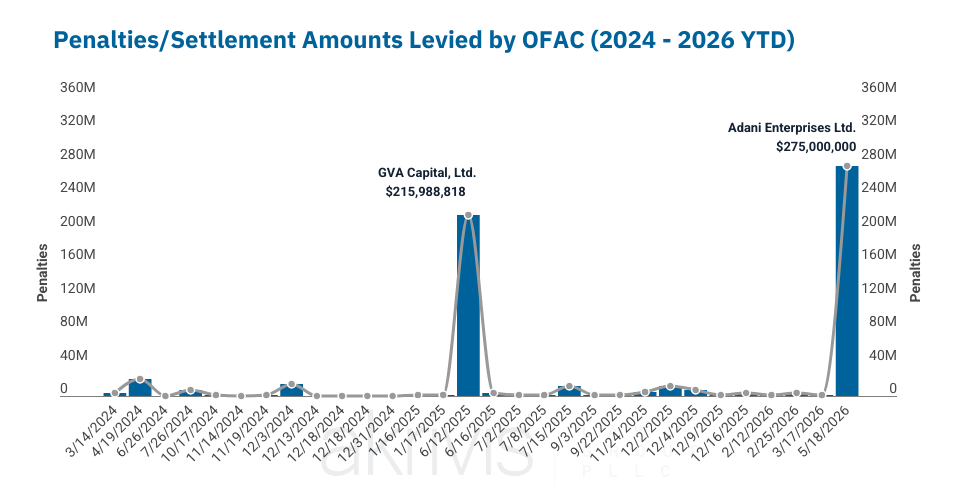
OFAC’s settlement with AEL is consistent with OFAC’s expanded sanctions enforcement against Iran’s energy sector, as discussed in depth in our recent legal update. Notably, to now, inclusive of AEL, OFAC has taken four enforcement actions in 2026, with the AEL settlement being the highest of the four, amounting to approximately 97% of the total $281,607,661 OFAC has levied this year. It is also worth noting that the $275 million penalty in this single case has independently surpassed the sum of all monetary penalties levied by OFAC in 2025 combined, which amounted to approximately $265 million.
.png)
Civil penalties of this scale for sanctions violations are comparatively rare, but not unprecedented. In June 2025, OFAC imposed a $215.9 million penalty on U.S.-based GVA Capital Ltd. for managing an investment account on behalf of a sanctioned Russian oligarch; and in another case from November 2023, OFAC reached a settlement with U.S.-based Binance Holdings, Ltd. for over $968 million for executing virtual currency trades on behalf of users in numerous sanctions jurisdictions.
These enforcements underscore that OFAC expects a higher level of compliance in large, sophisticated businesses.
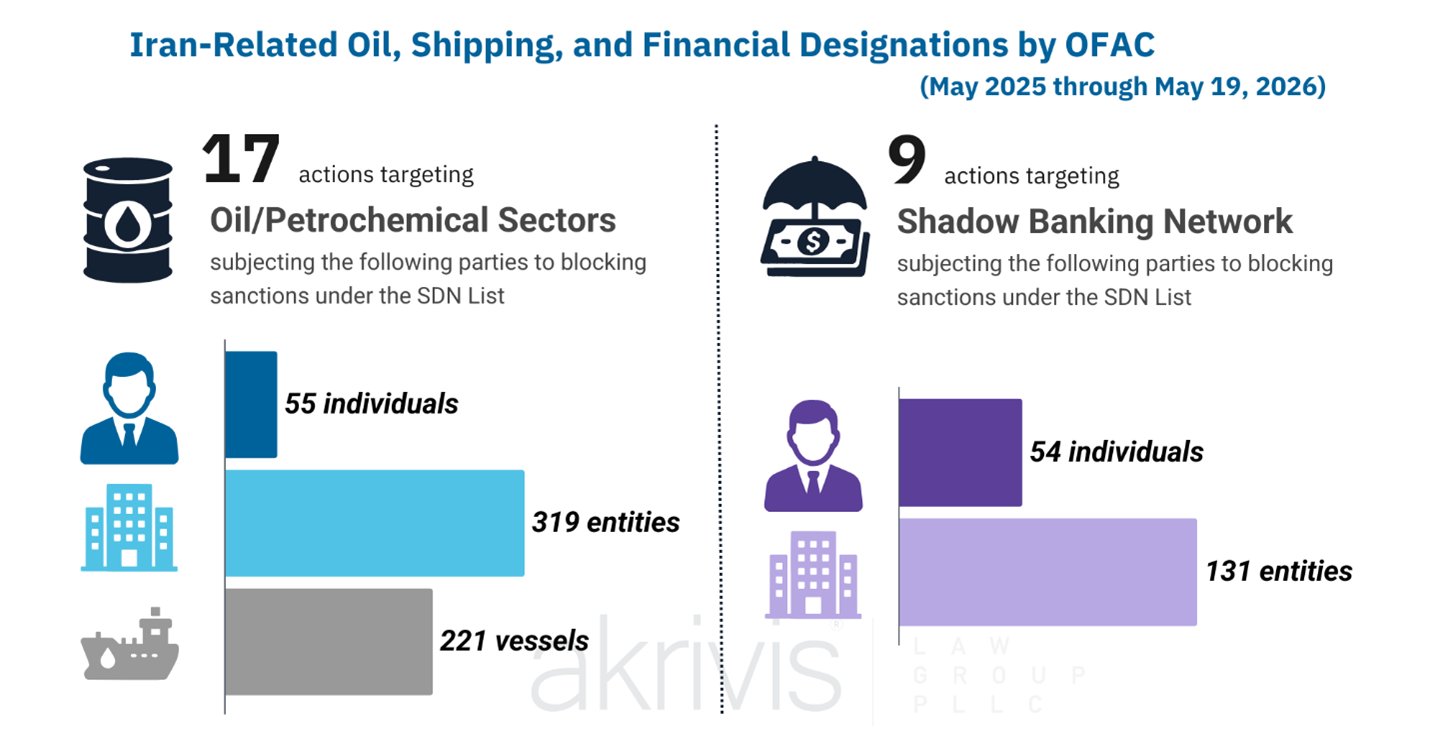
Beyond monetary penalty, non-U.S. person businesses face additional risk of secondary sanctions exposure and are more likely to be under heightened scrutiny than U.S. companies. This week’s penalty action against AEL aligns with the Trump Administration’s policy of Economic Fury designed to isolate Iranian oil exports from the global economy, and the broader maximum pressure policy targeting Iranian oil revenues altogether. This policy, the enforcement of which has accelerated over the last 12 months, has resulted in scores of designations onto OFAC’s SDN List, further pointing to the importance of heightened risk assessment and dynamic compliance protocols in global energy supply chains.
The $275 million penalty serves as another reminder for downstream buyers of oil and petroleum products, as well as financial institutions, to strengthen compliance at various stages of a transaction in light of evolving sanctions evasion tactics of bad-faith actors. The below are steps that companies may wish to consider:
- Verifying and corroborating the certificates of origin for energy products with sophisticated third-party due diligence proportional to risk and transaction value;
- Check shipping documentation for any indications of falsification such as unexplained delay in post-shipment issuance, nonsequential numberings, use of abnormal formatting, etc.;
- Review transaction details with heightened scrutiny and assess the terms of the transaction against commercial reasonableness given the sophistication level of related parties;
- Investigate red flags as soon as they appear, pause any suspected transaction until red flags have been cleared, and engage external counsel and/or diligence firms if necessary.
Finally, and perhaps most importantly, this case stands as a reminder that U.S. sanctions enforcement is not limited to U.S. companies and individuals. Foreign, non-U.S. entities are at particular risk not only of investigation, but as discussed above, secondary sanctions, which can include potential designation onto the SDN List, which will require the blocking of all assets in the United States or the possession of a U.S. person in which the blocked party has an interest, as well as a nearly across-the-board ban on trade in goods, services, and technologies with U.S. persons.
Please contact Farhad Alavi (Washington) at falavi@akrivislaw.com or +1.202.686.4859 if you have any questions.
Special thanks to John Kallas and Kristen Xiao for their assistance in preparing this Legal Update.
This Legal Update is intended solely for informational purposes and should in no way be construed as legal advice, nor shall the information shared here result in or constitute the formation of an attorney-client relationship with anyone who reads it. If you have any questions or are unclear on any of the subject matters addressed or discussed in this Legal Update, please consult a licensed legal professional.
1 https://storage.courtlistener.com/recap/gov.uscourts.nyed.524060/gov.uscourts.nyed.524060.34.0.pdf