.avif)
OFAC Expands Crackdown on Iran’s Energy, Logistics, and Finance Networks

Farhad Alavi, Partner, Washington, DC
May 12, 2026
In Brief:
- OFAC has in recent weeks accelerated enforcement action against Iran’s energy sector, including oil and petrochemicals, targeting players in Iran, China, and elsewhere, part of a broader effort that has been ongoing for over a year.
- The agency has also targeted Iran’s financial sector and payment systems by designating scores of entities outside Iran onto the SDN List.
- These actions reflect the Trump Administration’s policy of maximum pressure and “economic fury” on Iran and underscore the need for smarter, more dynamic compliance by companies operating globally, particularly in key sectors and regions.
Introduction
The U.S. Department of the Treasury’s Office of Foreign Assets Control (OFAC) has in recent weeks accelerated its targeting of Iran’s energy sector and related supply chains, designating a web of foreign refineries, payment facilitators, and exchange houses around the world, and clarifying its position on Iranian regime “toll” payments for safe passage in the Strait of Hormuz and dealings with Iranian digital exchanges. In addition to new rounds of designations, OFAC issued two Iran-related sanctions risk alerts – one for financial institutions, emphasizing the risks posed by independent oil refineries in China for their alleged role in transacting sanctioned Iranian crude oil,1 and a second clarifying that payments for the safe passage of vessels through the Strait of Hormuz bear sanctions risks for U.S. and non-U.S. persons regardless of payment method.2
Alongside OFAC’s actions, the Department of the Treasury’s Financial Crimes Enforcement Network (FinCEN) released an advisory yesterday reminding financial institutions of their reporting obligations under the Bank Secrecy Act (BSA) if they suspect activities related to financing for Iran’s the Islamic Revolutionary Guard Corps (IRGC). The advisory emphasizes activities related to laundering oil smuggling proceeds.3
These very recent actions underscore the Trump Administration’s expanding emphasis on targeting Iran’s oil sector and expanding sanction violations. Given the international reach of Iran’s vast web of sanctions circumvention, compliance challenges are pervasive and not limited to Iran. This effectively mandates companies in the oil and related sectors to exercise heightened vigilance.
Context
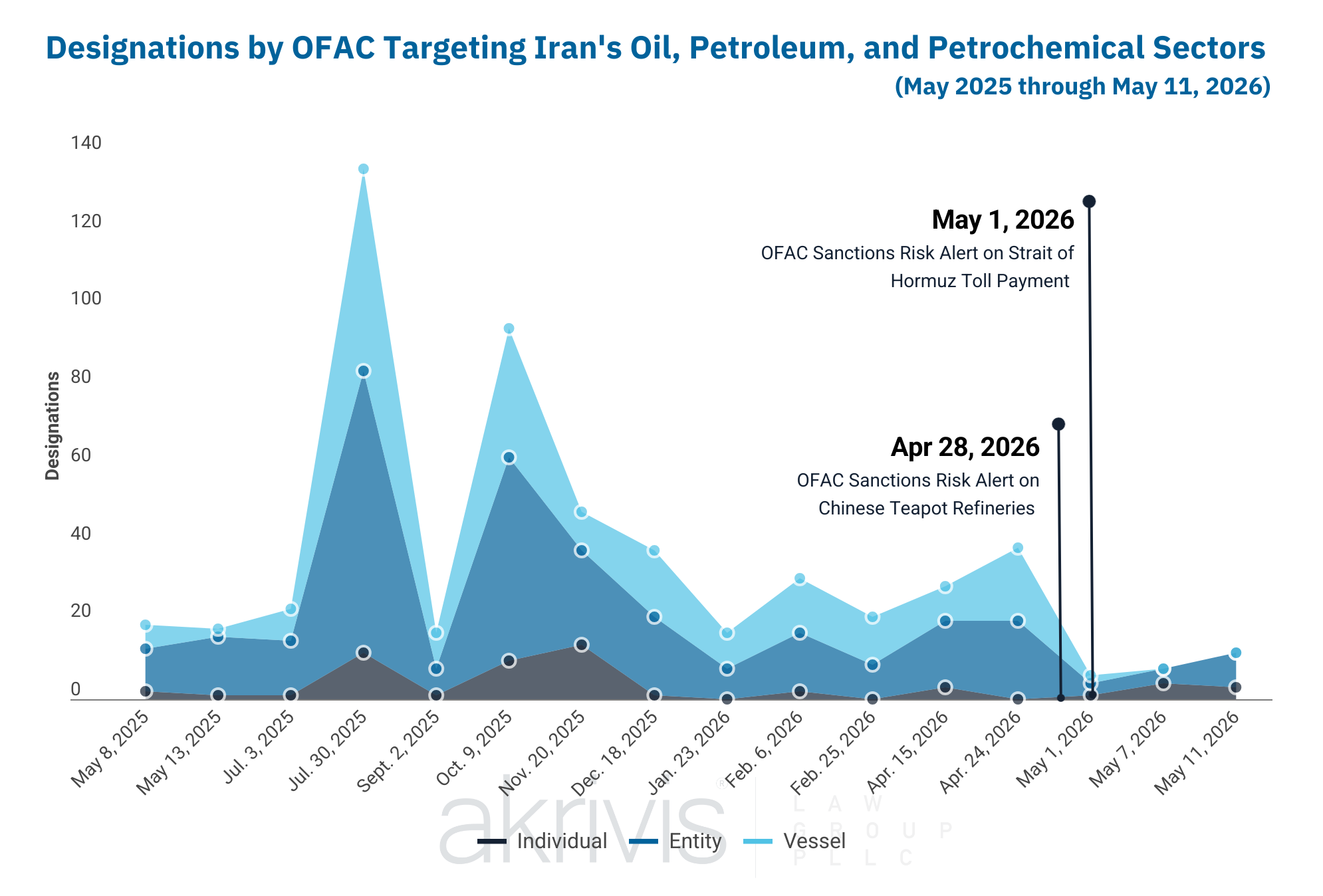
In a span of three days, OFAC issued two alerts on Iranian sanctions risks:
- April 28, 2026: Covering financial institutions of the risk in dealings with Chinese independent refineries, also known as “teapot” refineries, that could be purchasing and refining Iranian crude oil; and
- May 1, 2026: Clarifying that payments to Iran for passage through Strait of Hormuz bear sanctions risk for U.S. and non-U.S. persons.
Less than two weeks later, FinCEN issued an advisory on May 11, 2026 on reporting suspicious activities related to Iranian sanctions evasion, reminding financial institutions of the reporting requirements under the BSA on suspicious activities related to funding and facilitating the procurement networks supporting the IRGC, especially through use of front companies, facilitator networks, and digital assets. This Advisory also provided key red flags to consider in suspicious transactions.
These recent alerts underscore the Treasury Department’s commitment to maintain comprehensive sanctions on Iran and especially the country’s oil, petroleum, and petrochemical sectors. This is relevant not just for U.S. persons who are prohibited from transacting with any blocked entities, but also non-U.S. persons, which can face secondary and derivative sanctions exposure.
Targeting Iran’s oil and petrochemical sector and related shadow banking network
OFAC’s actions recent weeks, when reviewed in isolation or in the agency’s broader actions against Iran since last year, send a clear signal that Iran’s oil and petrochemical and the related shadow banking and shipment sectors are a key target as part of the broader maximum pressure campaign against the Iranian regime.
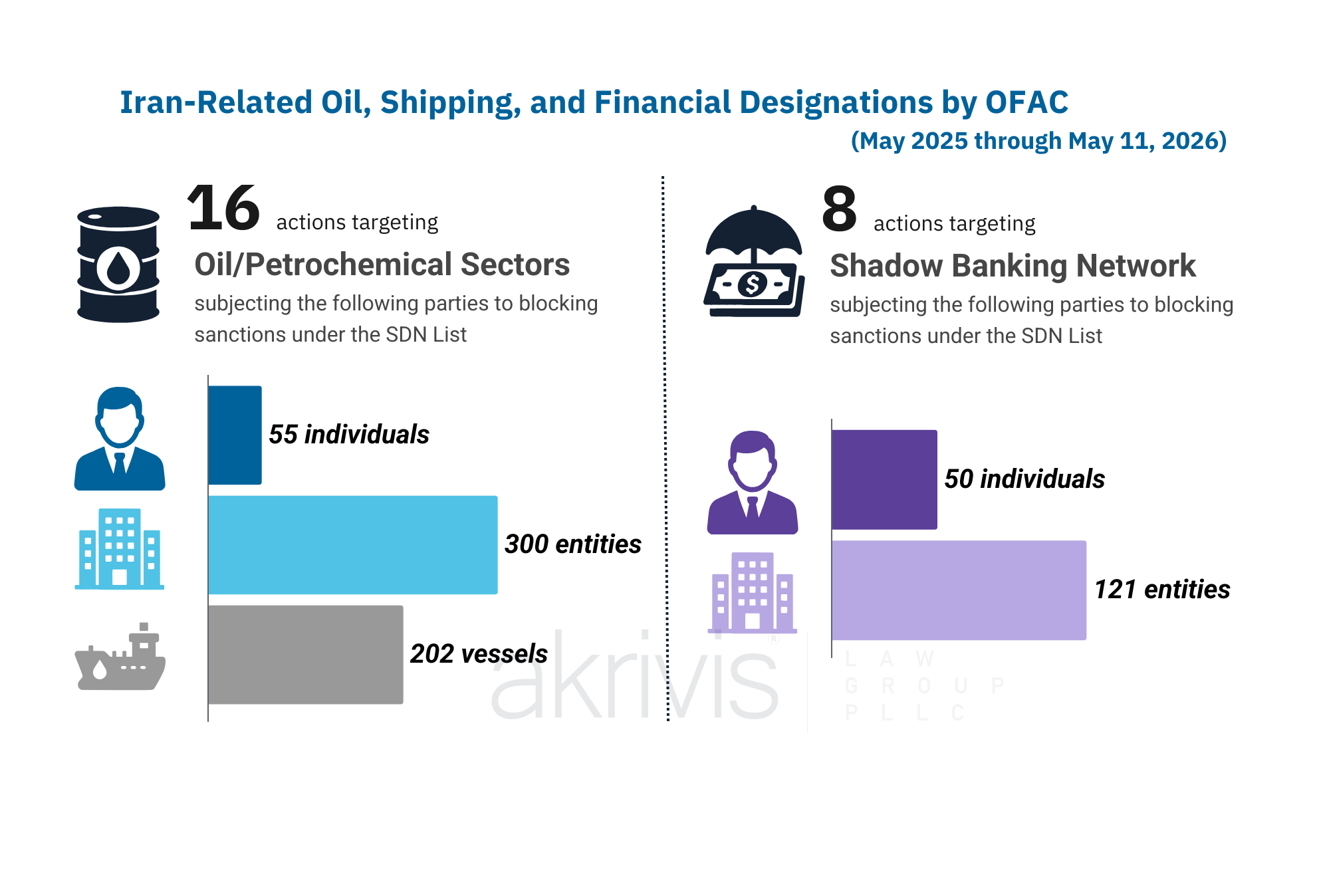
Specifically, OFAC has in the period since May 2025 taken:
- Oil and Petrochemical Sectors: 16 actions, resulting in the following additions to its List of Specially Designated Nationals and Blocked Persons (the “SDN List”):
- 55 individuals
- 300 entities
- 202 vessels
- Eight separate actions against Iran’s shadow banking networks that are often used to process oil-related payments, resulting in the following designations onto the SDN List:
- 50 individuals
- 121 entities
- Clarified via a Frequently Asked Question4 (FAQ) on its website that Iranian digital asset exchanges are considered blocked.
- Confirmed via another FAQ that sanctions prohibit payment to the Iranian regime and/or the IRGC by US persons and could expose foreign financial institutions to sanctions exposure.5
Many of these designations have been under Executive Order (EO) 13902 (January 10, 2020), a broad-based authority executed by President Trump in his first Administration allowing for the blocking of parties operating in key sectors of Iran’s economy. Other authorities include the Global Terrorism Sanctions Regulations, 31 CFR Part 594 (the “GTSR”), EO 13949 (September 21, 2020), and the Weapons of Mass Destruction Proliferators Sanctions Regulations, 31 CFR Part 544 (the “NPWMD”). OFAC has also relied on sectoral (non-blocking) authorities of the Iranian Financial Sanctions Regulations, 31 CFR Part 561 (the “IFSR”), with parties under this designation not being blocked (described below), but rather substantially limited in the scope of financial activities they can engage in with U.S. financial institutions.6
U.S. persons are generally prohibited from nearly all transactions in goods, services, and technology with parties on the SDN List, and any assets in which such parties hold an “interest,” a term OFAC defines broadly, that are in the United States or coming into the possession of a U.S. person (e.g., U.S. companies, citizens or permanent residents regardless of where in the world they are located, or any other person physically in the United States) must be blocked.
The effects can be far more pronounced as, under OFAC’s “50 percent rule,” entities owned in the aggregate 50% or more by blocked parties are themselves considered blocked and under the same restrictions as their upstream SDN owners. While all SDNs are “blocked,” not all blocked parties are SDNs. This is a key point - These entities are often not named on the SDN List, highlighting the need for increased vigilance in due diligence and compliance.
While the limitation on dealings with blocked parties are generally aimed at U.S. persons, such dealings can subject non-U.S. persons to derivative blocking, and today’s global derisking landscape in fields such as banking means blocked parties invariably face similar restrictions even outside the United States. Specifically, the designations can trigger a cascading “de-platforming” of these entities by non-U.S. businesses outside the United States, resulting in a loss in banking privileges, financial freezes, and broader limitations.
In addition to OFAC’s alerts, FinCEN’s May 11, 2026 alert on Iran’s shadow banking network, using BSA data published in October 2025,7 identified that shell companies linked to Iran moved roughly $5 billion in the global financial system in 2024.8 This supplements another FinCEN’s advisory from June 2025 on exchange houses and front companies being used to settle the proceeds from Iran’s oil and petrochemical trades.

The increased enforcement is not surprising due to the continuous evolution of sanctions evasion tactics used by parties dealing in Iran’s oil and gas and related sectors. More broadly, OFAC signaled in late March that it is looking beyond ownership and interests of blocked property to “underlying practical and economic realities” of transactions in its enforcement and designation actions.9 As a result, oil traders and financial institutions could inadvertently violate sanctions even if none of the transacting parties ostensibly have a connection to Iran and none are blocked pursuant to OFAC regulations or Executive Orders.
Examples of these less apparent sanctions violations include the “rebadging” of oil --- re-branding oil of sanctioned origin as originating from a non-sanctioned origin to bypass restrictive measures from buyers or intermediating parties. As such, a downstream transaction distanced from any blocked parties on paper and ostensibly bearing no evident reference to Iran could nonetheless run afoul of U.S. sanctions.10
The risk of sanctions violations for both U.S. and non-U.S. persons is especially salient in light of OFAC’s recent temporary authorizations for certain in-transit oil cargoes. In March 2026, OFAC temporarily eased sanctions on Iranian-origin oil through Iran-Related General License (GL) U, authorizing certain transactions involving in-transit Iranian-origin cargoes through April 19, 2026. Almost concurrently, on March 12, 2026, OFAC issued similar authorizations for in-transit Russian-origin oil GL 134, which was valid through April 11, 2026. As the origin of oil heavily can heavily impact the sanctions exposure associated with dealings in downstream products, bad-faith actors utilize alternative payment methods, front companies, or fraudulent identification to ship the sanctioned crude to teapot refineries. Notably, refining could make tracing the oil’s origin logistically more difficult, involving the use of petroleum forensics on certain isotopic footprints. By imposing pressure on the entire supply chain of Iranian oil, OFAC ensures that the chemical transformation inside a refinery cannot be abused as a legal shield to mask the sanctioned crude origin of non-sanctioned refined products.
A second key focus of the Treasury Department’s enforcement is on Iran’s multi-jurisdictional shadow banking networks, as highlighted in the recent FinCEN advisory. Given the de facto lack of formal links between Iranian banks and their foreign counterparts (e.g., by disconnecting them from SWIFT and correspondent banking relations), Iran has in recent decades increased reliance on third country exchanges and paying agents, as well as triangulated payments. While such entities are often for legitimate purposes, they can enable illicit proceeds from sanctioned oil sales to repatriate to the Iranian regime. OFAC highlighted this issue in January when targeting numerous so-called “rahbar” companies, basically overseas agents of Iranian financial institutions that handle hard currency and international trade transactions for Iran by proxy.
Shadow banking networks commonly use Iranian exchange houses to manage front and trading companies, exploiting gaps in regional bank reporting requirements, such as policies intended to ease banking friction in commercial free trade zones, to open accounts and conduct large, opaque transactions. Other networks falsify the source of funds to evade detection by regional banks with U.S. correspondent banking relationships, allowing foreign currency to be converted into U.S. dollars. These types of fraudulent and opaque structures, by design, make U.S. and non-U.S. financial institutions prone to inadvertently moved illicit funds through the global financial system.
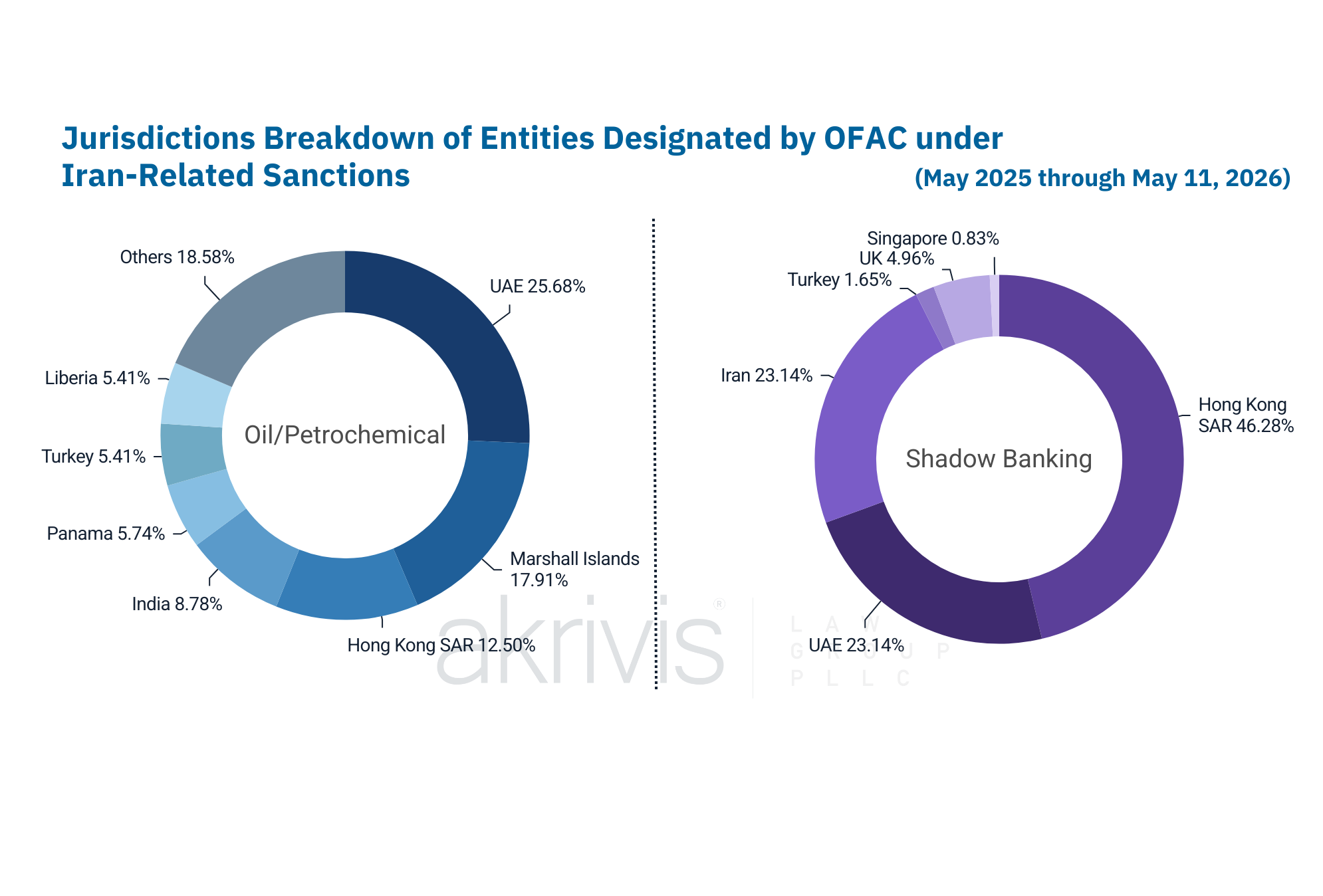
OFAC’s enforcement appears to reflect a commitment to close the banking gaps. Notably, common third-country jurisdictions for such front companies are also among the top targeted jurisdictions for shadow banking enforcement, and increasingly such countries are cooperating in a crackdown on illicit Iranian activities. Additionally, as digital wallets rise in prevalence, especially among illicit financial operators to evade detection common to a traditional banking environment, OFAC also targeted crypto-based funds facilitators in the September 16, 2025 designations, IRGC-linked digital asset exchange on January 30, 2026, and facilitators building circumvention infrastructure in other actions. In particular, OFAC listed digital currency addresses for two coordinators of crypto-based sales in its September 16, 2025 notice.11
Key Takeaways
OFAC and FinCEN’s recent actions reflect a concerted effort to target activities that provide funding for the Iranian regime and recent enforcement action should be viewed in the broader context of the current U.S.-Iran conflict and the Trump Administration’s maximum pressure campaign against Iran. Current geopolitics driving down the supply of oil and the de facto closure of the Strait of Hormuz has not only disrupted supply chains but could easily accelerate sanctions exposure risks, OFAC and FinCEN’s alerts provide a window to the private sector into the Treasury Department and more broadly, the executive branch’s sanctions enforcement priority, noting that this policy could easily lead to more criminal enforcement of violations as well both for companies, and perhaps more likely for individuals, such as corporate executives and traders.
As with most sanctions enforcement, players in the energy and logistics as well as related sectors should be cognizant of and responsive to the shifting legal and enforcement landscape and respond to the ever-evolving risks presented. While foreign companies doing business in this sphere risk blocking sanctions, civil and criminal enforcement, U.S. companies and individuals can face civil and criminal penalties for similar allegations.
Given this reality, U.S. and non-U.S. businesses and executives can, in consultation with expert counsel and compliance specialists:
- Become fully aware of key sector-specific risks and not being willfully unaware. These include:
- Evolving trends and patterns in sanctions evasion tactics, defining key red flags
- The use of intermediary and front entities in both procurement and financing
- Supply chains
- Supporting logistics infrastructure (e.g., payment systems and shipping)
- “Phantom” Iran related transactions – these can be illicit sales and payments for the benefit of Iran and/or blocked entities where no parties appear to be Iranian or connected to Iran, nor blocked
- Procurement or payment opportunities that look “too good to be true”
- Strange or atypical payment methods
- Respond to shifting risks. This is done by:
- Defining risk appetite based on knowledge of the above
- Systematically incorporating heightened and expanded counterparty due diligence, including robust “know your customer” (KYC) and “know your customer’s customer” (KYCC) approaches, with a clear strategy to obtain truthful ultimate beneficial owner (UBO) information to determine potential blocking or simply diversion and even reputational risks
- Identifying thresholds for when to rely on expanded business intelligence beyond internal “in house” capabilities, such as those offered by third party diligence providers and whether to invest in broader based diligence tools; and
- Expanding and strengthening contractual representations and warranties, covenants, and force majeure clauses in agreements to address and mitigate sanctions exposure.
- Periodically reassessing risk appetite and risk management approaches and tailoring processes based on sectoral shifts and changing geopolitical realities.
- Understanding that as the regime seeks to rebuild facilities and plants damaged from U.S. and Israeli attacks that obscure, shadowy procurement behavior and processes may emerge, and U.S. enforcement against such activities will likely accelerate on both civil and criminal fronts
The Treasury Department’s actions vis-à-vis Iran in many ways reflects the broader contours of U.S. sanctions and export control policies – ever-expanding and underscoring the need for compliance. Such compliance is becoming increasingly challenging given the increasing complexities of regulatory frameworks and the expansion of prohibited parties lists such as the SDN List. This highlights the need for relentless attentiveness, hypervigilance, and by extension, properly directing company resources to understand and meet these needs.
Please contact Farhad Alavi (Washington) at falavi@akrivislaw.com or +1.202.686.4859 if you have any questions.
Special thanks to Kristen Xiao for her help with this Legal Update.
This Legal Update is intended solely for informational purposes and should in no way be construed as legal advice, nor shall the information shared here result in or constitute the formation of an attorney-client relationship with anyone who reads it. If you have any questions or are unclear on any of the subject matters addressed or discussed in this Legal Update, please consult a licensed legal professional.
1U.S. Dep’t of the Treasury, Office of Foreign Assets Control, Sanctions Risk of Dealing with Teapot Oil Refineries (Apr. 28, 2026), https://ofac.treasury.gov/media/935546/download?inline.
2U.S. Dep’t of the Treasury, Office of Foreign Assets Control, Sanctions Risks of Iranian Demands for Strait of Hormuz Passage (May 1, 2026), https://ofac.treasury.gov/media/935556/download?inline.
3https://www.fincen.gov/system/files/2026-05/FinCEN-Alert-IRGC.pdf.
4U.S. Dep’t of the Treasury, Office of Foreign Assets Control, Frequently Asked Questions No. 1250 (May 1, 2026), https://ofac.treasury.gov/faqs/1250.
5U.S. Dep’t of the Treasury, Office of Foreign Assets Control, Frequently Asked Questions No. 1249 (Apr. 28, 2026), https://ofac.treasury.gov/faqs/1249.
631 CFR § 561.309.
7U.S. Dep’t of the Treasury, Financial Crimes Enforcement Network, Iranian Shadow Banking: Trends in Bank Secrecy Act Data (Oct. 23, 2025), https://www.fincen.gov/system/files/2025-10/FTA-Iranian-Shadow-Banking.pdf.
8U.S. Dep’t of the Treasury, Financial Crimes Enforcement Network, FinCEN Alert on the Use of Front Companies, Financial Facilitators, and Digital Asset Infrastructure by Iran’s Islamic Revolutionary Guard Corps to Evade Sanctions and Launder Proceeds (May 11, 2026), https://www.fincen.gov/system/files/2026-05/FinCEN-Alert-IRGC.pdf.
9U.S. Dep’t of the Treasury, Office of Foreign AssetsControl, Guidance on Sham Transactions and Sanctions Evasion (Mar. 31, 2026), https://ofac.treasury.gov/media/935441/download?inline.
10ld.
11U.S. Dep’t of the Treasury, Office of Foreign Assets Control, Counter Terrorism Designations (Sept. 16, 2025), https://ofac.treasury.gov/recent-actions/20250916.