Akrivis Law Group, PLLC Welcomes Nick Turner as Partner, Boosting Sanctions, AML, and White-Collar Practices
Washington, D.C. — Akrivis Law Group, PLLC is pleased to announce that Nicholas (Nick) Turner, a globally recognized lawyer in the field of sanctions, anti-money laundering (AML), and export controls, has joined the firm as Partner in its Washingtons, D.C. office.
Now based primarily in the United States, Nick joins Akrivis from the Hong Kong operations of leading global digital asset exchange Binance, where he most recently served as Global Sanctions Lead Counsel. His addition strengthens Akrivis’s already robust sanctions, AML, export controls, anti-bribery, and white-collar defense capabilities, bringing over a decade of experience advising leading international financial institutions and multinationals in one of the world’s top financial hubs.
Nick has advised clients throughout Asia, the Americas, Australia, Europe, and the Middle East in the financial services, digital assets, telecommunications, logistics, e-commerce, aviation, and other sectors. He helps companies understand when and how regulations apply to their business, how to respond when regulators come calling, and how to approach transactions to mitigate risks from regulations, counterparty requirements, and geopolitics.
Nick’s experience also includes acting as in-house counsel for a UK-headquartered financial institution and as external counsel in the Hong Kong offices of major U.S.- and U.K.-based law firms. He has advised clients throughout Asia, Australia, Europe, the Middle East, and the Americas in the financial services, digital assets, telecommunications, logistics, e-commerce, aviation, and other sectors. Nick’s work spans compliance, regulatory enforcement, investigations, and transactional support across multiple jurisdictions and regulatory regimes. In recent years, he has extensively advised on key issues related to U.S.-China tensions, multilateral sanctions against Russia, and the evolving Middle East landscape.
“Akrivis was my first choice,” Nick said. “The firm has built a reputation for advising clients on exactly the kind of complex, cross-border matters I've spent my career working on. What drew me here is the opportunity to give companies straightforward advice in plain language — informed by first-hand experience of how these rules actually land on businesses operating outside the United States."
“Whether a client is interpreting a new regulation, deciding how to approach a transaction, or build a compliance program, I am ready to help,” Nick said.
“Nick brings a very unique perspective that very few U.S. lawyers offer in this space,” said Farhad Alavi, Akrivis Managing Partner. “This is a logical and strategic step in Akrivis’s expansion trajectory, aligned with our recent ascent in our core practices, and will boost our already robust representation of clients around the globe. His diverse experience, including years of practice in Hong Kong, gives him a perspective on the logistics of international sanctions, and money and technology flows involving China that very few people in this sector can match. This translates to advice clients can readily use."
In addition to his legal practice, Nick co-developed and taught a course on Sanctions Law and Practice at the University of Hong Kong, in which students explored how complex sanctions laws and regulations apply to corporate actors. He has authored several book chapters on corporate decision-making about sanctions and served as co-editor of the Global Investigations Review (GIR) Practitioners' Guide to Sanctions. He was recognized as a Global Investigations Review 40 Under 40 investigations specialist and is a Certified Anti-Money Laundering Specialist (CAMS).
Nick is admitted to practice in the State of New York. He divides his time between North America and Hong Kong. Nick can be reached at nturner@akrivislaw.com.
Joint Enforcement: The U.S. Department of Justice (“DOJ”) National Security Division ("NSD") and U.S. Department of Commerce’s Bureau of Industry & Security (“BIS”) on June 17 announced significant penalties against Robert Bosch GmbH (“Bosch”) for alleged violations of U.S. export control prohibitions against China’s Huawei Technologies Co., Ltd. and related affiliates (collectively, “Huawei”).
These violations resulted from a misreading of the scope of the Foreign Direct Product Rule (the “FDP Rule”) by company personnel, leading the company to incorrectly conclude that its non-U.S.-produced items were not subject to the jurisdiction of the Export Administration Regulations (“EAR”).
This enforcement action involves severe penalties - $36 million in BIS penalties and an $11.4 million disgorgement of profits by the DOJ, $7.8 million of which was credited towards the BIS penalty. Bosch, a $90 billion company, has hired 66 additional compliance officers as part of its mitigation efforts (throughout most of the period at issue, the company had two employees in the U.S. serving in the compliance function).
First Declination of an NSD matter under the DOJ’s Corporate Enforcement and Voluntary Self-Disclosure Policy (“CEP”): DOJ made clear that Bosch received this declination after voluntarily self-disclosing the misconduct, fully cooperating with the government’s investigation, timely and appropriately remediating the root causes of the violations, and in the absence of aggravating factors, making it a first of its kind case under the CEP.
The Case for Refined Compliance Management: Expanding compliance as a mitigation and risk prevention strategy for future violations is commonplace. Despite being a $90 billion company with offices in over 60 countries, compliance was poorly managed. In addition to the dearth of adequate resources, management had failed to ensure consistent compliance across the group’s international operations. Spotty compliance can dramatically elevate the likelihood of compliance breaches even in the largest, most sophisticated companies with comprehensive policies.
Background:
An international technology and services company headquartered in Germany, Bosch produces sensors and software that were provided to Huawei, which was placed on the BIS Entity List in 2019. The items in question were produced outside of the U.S. but determined by BIS to be subject to the export control restrictions under the EAR. This was based on the timeline below:
Compliance Takeaways:
The Bosch Declination could signal the NSD’s increased use of the CEP and reliance on the DOJ Principles of Federal Prosecution of Business Organizations The Bosch declination may provide insight into how DOJ intends to apply both its new Department-wide CEP and the Principles of Federal Prosecution of Business Organizations in export controls and national security matters. The Department-wide CEP announced in March 2026 largely builds upon the Criminal Division's longstanding Corporate Enforcement Policy, which originated in the FCPA arena and rewards companies that voluntarily self-disclose misconduct, fully cooperate, and timely remediate compliance deficiencies.1 Bosch, as the first NSD declination under the same policy, suggests DOJ is applying a consistent enforcement approach across traditionally separate enforcement areas. As a result, companies confronting potential export controls violations may increasingly evaluate disclosure decisions through a framework familiar to FCPA practitioners: absent significant aggravating factors, prompt self-disclosure, robust cooperation, and meaningful remediation may substantially reduce the risk of criminal prosecution. In Bosch’s declination letter, the NSD highlighted several remediation efforts taken by the company, demonstrating the substantial development of Bosch’s trade compliance policies. Following the investigation, the company hired 66 employees to its trade compliance team, broadly expanded U.S. trade compliance resources, and updated its internal policies to clarify when U.S. export control jurisdiction and licensing requirements apply to the business’s activities.
According to the DOJ, these efforts, along with Bosch's voluntary self-disclosure and extensive cooperation throughout the investigation, weighed heavily in favor of a declination rather than criminal prosecution.2 As such, the matter may serve as an early roadmap for companies evaluating whether to voluntarily disclose potential export controls violations to DOJ, and what steps can be taken after the fact to mitigate the risk of prosecution. As U.S. export controls and broader economic policy continue adapting to meet evolving national security priorities, DOJ’s CEP encourages prompt disclosure, cooperation, and remediation efforts through sophisticated corporate compliance protocols and mechanisms.
Businesses worldwide should develop a sophisticated understanding of FDP Rules Importantly, the EAR’s jurisdiction can extend far beyond shipments originating from or transiting through the U.S., as can be seen in the FDP Rules. The Huawei FDP Rule covers Huawei and its non-U.S. affiliates (so-called “Footnote 1 entities”). In the Bosch case, the compliance team’s confusion in the product scope provisions of the August 2020 FDP Rule helped cause continuous violations.
Broadly, the FDP Rules3 extend U.S. jurisdiction to foreign-made products that are direct products of certain export-controlled technology or software that is subject to U.S. jurisdiction or made on equipment that is itself a direct product of such technology or software. These rules continue to evolve in accordance with foreign policy objectives and strategies that companies use to evade export controls.
Distinguish De Minimis Rule and the FDP Rule: Content vs. Technology Another key mistake Bosch’s compliance personnel made was conflating the de minimis rules, which was the long-established approach to determining whether a foreign-made product was subject to the EAR, with the FDP Rules, which substantially expanded the universe of foreign-made items subject to the EAR. One internal email erroneously determined that the products in question, Micro-ElectroMechanical Systems ("MEMS") sensor products and CycurHSM automotive firmware, were not subject to the EAR because the U.S.-origin content in each product fell below the de minimis threshold.
The De Minimis Rule calculates the value of U.S.-origin content as a percentage over the total value of the product and establishes a threshold below which the product generally is not subject to the EAR (25% for the purposes of exports to most destinations).4 The FDP Rules and in particular the Entity List FDP Rule implemented in August 2020 and with certain modifications dedicated specifically to Huawei (so-called “Footnote 1 designations”), expanded U.S. jurisdiction by focusing not on the percentage of U.S.-origin content, but on whether the foreign-made product is a direct product of certain export-controlled technology or software that is subject to U.S. jurisdiction, or made on equipment that is itself a direct product of such technology or software. In Bosch’s case, some of the MEMS sensors were manufactured using epitaxy machines that were the direct product of U.S.-origin technology or software as defined in paragraph (e)(1)(i)(B) of the FDP rule, and the microcontrollers used to test the CycurHSM software were likewise determined to be direct products under the same rule.
The Bosch enforcement underscores that compliance teams must assess both the de minimis and FDP Rules when evaluating EAR jurisdiction involving foreign-made products.
Streamline organizational response to potential red flags or violations.
Bosch’s organizational response leading up to the violations highlights certain definitive lessons for businesses adapting their trade compliance practices to evolving regulatory landscapes and the complexity of their business practices.
Prioritize staffing and coordination of trade compliance teams across regions. Bosch’s case highlights a common phenomenon of confusion over the U.S. export controls regime even among compliance personnel in major multinationals, and the imbalances of compliance program implementation and staffing know-how seen across global operations, even at some of the most prominent companies Multinational companies face continual challenges in equipping trade compliance teams with sufficient resources to adequately address new and complex regulatory changes. Such resources should include sufficient staffing as well as access to advanced legal expertise to check the internal interpretation of complex rules such as the FDPRs. While the particulars of training and guidance at Bosch are unclear, as a general matter, many multinationals’ foreign operations effectively function as islands, without central, top-down compliance directives and training. This can result in erratic “lone wolf” activity, dramatically expanding exposure to violations.
Integrate compliance teams into relevant decision-making processes. Bosch’s violations resulted from information asymmetry between trade compliance professionals and executives from BST, a Bosch subsidiary. Had Bosch’s trade compliance team obtained information about the production equipment, suppliers, and end-users, they may have been able to properly complete the analysis for applicability of the FDP rule. Communication with trade compliance teams, including questionnaires, guidance, and warnings, should be given high regard in the decision making related to all stages of production and distribution of an item.
Calibrate compliance processes to adequately respond to warnings and red flags. BIS’s release identified multiple warnings from outside vendors and supply chain partners to BST that were not properly addressed. Compliance teams should have clear authority to respond to such warnings while keeping senior management informed. Management, by contrast, should maintain internal review and accountability mechanisms to prevent reliance on incorrect or outdated guidance, which in this case contributed to continued violations of the export control rules. Management should ensure consistent training and resources across divisions as needed.
Promptly investigate any potential compliance issues, disclose any violations and cooperate with BIS and other regulatory agencies. BIS expects proactive due diligence and internal investigatory protocols if and when a compliance concern arises. Bosch received significant credit from BIS and DOJ for eventually conducting a full investigation and submitting a VSD to the DOJ covering its violations.
While the penalties were steep, by voluntarily self-disclosing and taking bona fide, earnest steps to remediate, Bosch materially mitigated what could have been a much larger punishment. The case for companies operating in sensitive sectors maintaining export control compliance is clear and not novel. More importantly, however, this particular matter highlights the need for comprehensive compliance maintenance, namely:
adequate resource allocation;
accurate and thorough advice; and very importantly
proper compliance management and consistency of internal implementation and communication.
In addition to typically having only two compliance employees tasked with providing U.S. export controls guidance to the entire global group, Bosch was also insufficiently advised and lacked proper mechanisms for implementing group-wide compliance. Beyond proper resource allocation, companies should strongly consider top-down and bottom-up compliance quality control and risk management policies adequately addressing new developments to avoid miscommunications and “compliance deserts” often found in cross-border operations within a group or conglomerate.
Special thanks to John Kallas and Kristen Xiao for their assistance in preparing this Legal Update.
This Legal Update is intended solely for informational purposes and should in no way be construed as legal advice, nor shall the information shared here result in or constitute the formation of an attorney-client relationship with anyone who reads it. If you have any questions or are unclear on any of the subject matters addressed or discussed in this Legal Update, please consult a licensed legal professional.
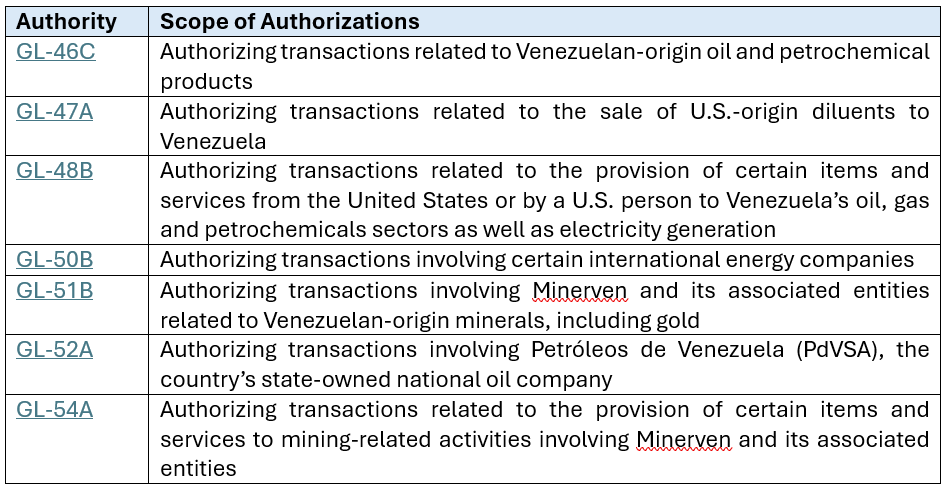
On June 10, 2026, the U.S. Department of the Treasury’s Office of Foreign Assets Control (OFAC), issued Venezuela-related General Licenses (GLs) 46C, 47A, 48B, 50B, 51B, 52A, and 54A.
These amend existing GLs authorizing a broad range of activities within Venezuela’s energy, mining, and minerals sectors, but with two noteworthy changes:
Broadening the scope of dispute resolution venues allowed for agreements authorized by the GLs beyond the United States to include the United Kingdom, France, and Singapore -- three main seats for international arbitration and all jurisdictions friendly to U.S. allies while shifting language from requiring such agreements by “governed by” the laws of a U.S. jurisdiction to being construed and interpreted under the such laws, affording flexibility for foreign dispute resolution; and
Clarifying that compliance with certain Venezuelan laws and regulations related to labor, safety, environmental, and administrative licensing in the course of activities authorized by the GLs is authorized.
These significant changes mitigate potential compliance confusion and inconveniences for U.S. and non-U.S. businesses partaking in economic activities the GLs are designed to authorize, and in the case of non-U.S. persons, encourage participation in Venezuela’s new political landscape, thereby furthering U.S. policy goals. The amendments also signal OFAC’s commitment to addressing practical challenges that might deter businesses from investing in Venezuela’s economy.
Such changes suggest potentially more upcoming modifications and clarifications as OFAC refines its policies based on private sector feedback, not just vis-à-vis Venezuela, but in other sanctions frameworks. OFAC may also implement similar authorizations accounting for the practical preferences and realities of U.S. multinational companies and their counterparts in friendly jurisdictions.
Background:
OFAC yesterday issued updated versions of seven Venezuela-related General Licenses (GLs) 46C, 47A, 48B, 50B, 51B, 52A, and 54A, covering oil exports, U.S. diluent sales, energy services, mining activities involving CVG Compañía General de Minería de Venezuela CA (Minerven), transactions with Petróleos de Venezuela, S.A. (PdVSA), and operations by major international energy companies. 1 All seven, issued under the authority of the Venezuelan Sanctions Regulations, 31 CFR Part 591 (the “VSR”) took effect immediately, replacing previous versions issued between February and March 2026.2 Crucially, none have expiration dates.
The amended GLs continue to instruct relevant parties to facilitate payments made to authorized parties that are otherwise blocked to the Foreign Government Deposit Fund or another account as instructed by the Treasury Department, pursuant to Executive Order (E.O.) 14373 (January 9, 2026).3 Payments made for local taxes, permits, or fees relating to relevant transactions with authorized Venezuelan entities need not be facilitated in this manner. Importantly, the aforementioned GLs do not authorize transacting with parties that are designated onto the List of Specially Designated Nationals and Blocked Parties (the SDN List) in connection with entities other than those included in the GLs, and businesses must take a holistic approach to prospective and current transactions to ensure compliance and address risks accordingly.
The updated GLs issued yesterday incorporate two noteworthy changes:
OFAC has expanded the scope of permissible venues for dispute resolution to include the United Kingdom, France, and Singapore in agreements authorized by the GLs.4 Previously, dispute resolution proceedings could only occur in the United States.5 Similarly, the previous GLs required that the agreements be “governed by” the laws of a U.S. state or jurisdiction in the U.S., while the amendments require that they merely be “construed or interpreted” under the laws of such jurisdictions – enabling parties to alternative dispute resolution procedures to utilize the procedures of the respective fora, even if they are outside the United States.
These revisions clarify that while agreements must be “Construed or interpreted” under governed by the laws of a U.S. state or jurisdiction in the U.S., this does not preclude recognition of and adherence to applicable Venezuelan law on labor, environmental compliance, administrative permits, health and safety, and other sovereign regulatory functions.6
These are addressed in detail below.
Inclusion of Non-U.S. Dispute Resolution Venues
The previous GLs specified in Paragraph (a)(1) that the laws of a U.S. state or other jurisdiction in the U.S. govern the contract and that any dispute resolution under the contract must occur in the United States.7 Although the newly issued GLs maintain that the terms of relevant agreements must be construed in accordance with the laws of a U.S. state or other jurisdiction in the U.S., they provide that dispute resolution proceedings may occur in three additional venues: the United Kingdom, France, or Singapore.8 Furthermore, OFAC FAQ 1260 provides that if the parties were to submit their dispute to arbitration, applicable procedural rules include those agreed upon by the parties, the rules of internationally recognized institutions, or the rules of the seat of arbitration.9
Significance:
Recognizes Compliance Challenges of Multinational Companies. Providing the option for three additional dispute resolution venues outside the United States, each with leading arbitral fora, acknowledges practical compliance challenges faced by international companies and investors that these GLs are intended to enable.
Aligns with International Standards and Practices. The modification permits increased flexibility to align such agreements to existing contractual practices in accordance with more globally established practices, accommodating the preferences of multinationals, allowing, for example, the use of arbitration at established venues such as the London Court of International Arbitration (LCIA), The International Chamber of Commerce (ICC) in Paris, or the Singapore International Arbitration Centre (SIAC). Notably, among the entities permitted by GL 50B (previously GL 50A), BP PLC, Eni S.p.A., Établissements Maurel & Prom SA, Repsol S.A., and Shell PLC are based in the United Kingdom or the European Union.
The additional three arbitration venues reflect international trends in the sector.
As detailed above and as FAQ 1260 affirms, the United Kingdom, France, and Singapore, are each home to a main global arbitration seat which collectively represent the world’s three major seats. For alternative dispute resolutions, given that many multinational energy companies are headquartered in the United Kingdom and France, these countries are preferred, reliable venues that are well known by the commercial sector. By introducing these jurisdictions, OFAC is also facilitating transactions with Venezuela by offering non-U.S. persons and Venezuelan parties more international, less-U.S.-centric alternatives that also may convey a broader sense of neutrality to businesses. Concurrently, by continuing to require U.S. jurisdiction laws to govern agreements relying on these authorizations, OFAC is ensuring that it does not greenlight activities that could contravene U.S. policy.
Clarifications on Compliance with Venezuelan Laws and Regulations
The second change in the current versions of the GLs clarifies the first part of the requirements in paragraph (a)(1): while the contracts must be construed and interpreted under the laws of a U.S. state or other jurisdiction in the U.S., the contracts can recognize compliance with applicable Venezuelan laws and regulations in certain activities such as administrative permits and licenses, concessions, labor, environmental, health and safety, and other mandatory regulatory requirements.10
Significance:
Conveys OFAC’s recognition of the practicalities of day-to-day operations of a multinational business in-country. The change also aligns the Administration’s policy without encumbering it with limitations that do not materially benefit that policy. Allowing LCIA, ICC, or SIAC arbitration for such agreements increases the likelihood of the arrangements envisioned by the Trump Administration materializing without compromising U.S. policy objectives of keeping disputes over such contracts from being heard in less friendly jurisdictions.
Prevents Needless Deterrence and Derisking. By clarifying the policy, OFAC has removed key ambiguity by providing pointed direction. This addresses a common shortcoming of GLs which causes parties, especially those outside the U.S., to adopt risk-averse positions far exceeding limitations imposed by law.
What Should Businesses Expect?
Accommodation of Operational Challenges: The amended GLs reflect a pragmatic commitment by OFAC and the Treasury Department to make certain sectors of the Venezuelan economy accessible to U.S. investment and investment from certain non-U.S. companies. The current authorizations signal continuous efforts by OFAC to accommodate practical and legal challenges faced by multinationals seeking to participate in the Venezuelan economy in adherence to these licenses, while putting U.S. interests at the forefront.
Alignment with Venezuelan Reform Efforts: This development reflects the January 2026 amendments to Venezuela’s Hydrocarbons Laws, which (1) ease the state’s control in foreign private investments, and (2) allow for independent arbitration of disputes. The amended GLs effectively serve as an acknowledgment by the United States of legislative changes by Venezuela’s government. At the same time, the updated authorizations continue enabling investments in Venezuela’s energy sectors despite complex transactional and legal compliance challenges.
Persisting Compliance Considerations: Importantly, the current GLs only provide partial relief of U.S. sanctions targeting Venezuela. Businesses must continue conducting vigilant due diligence and seek guidance when applicable to ensure their activities remain compliant with the authorizations established by these GLs.
Possible Emerging U.S. Sanctions Policy Trends: Yesterday’s updates address both the engagement of U.S. allies vis-à-vis Venezuela as well as operational practicalities. Such liberalizations are being implemented at a more calibrated pace compared to the near-overnight changes seen with the Syria sanctions and export controls framework following the fall of Bashar Assad’s government in 2024, accounting for the contrasting underlying political shifts and policies. Importantly, it could provide a model for OFAC in issuing future relief when unraveling or phasing out other sanctions frameworks. OFAC will likely continue incorporating market feedback on sanctions implementation and revise conditional authorizations as needed, enabling routine, inoffensive activities necessary to facilitate commercial transactions the agency views favorably.
Special thanks to John Kallas and Kristen Xiao for their assistance in preparing this Legal Update.
This Legal Update is intended solely for informational purposes and should in no way be construed as legal advice, nor shall the information shared here result in or constitute the formation of an attorney-client relationship with anyone who reads it. If you have any questions or are unclear on any of the subject matters addressed or discussed in this Legal Update, please consult a licensed legal professional.
Citations:
[1] U.S. Dep’t. of the Treas., Off. of Foreign Assets Control, Venezuela General License No. 46C, “Authorizing Certain Activities Involving Venezuelan-Origin Oil or Petrochemical Products”; U.S. Dep’t. of the Treas., Off. of Foreign Assets Control, Venezuela General License No. 47A, “Authorizing the Sale of U.S.-Origin Diluents to Venezuela”; U.S. Dep’t. of the Treas., Off. of Foreign Assets Control, Venezuela General License No. 48B, “Authorizing the Supply of Certain Items and Services to Venezuela”; U.S. Dep’t. of the Treas., Off. of Foreign Assets Control, Venezuela General License No. 50B, “Authorizing Transactions Related to Oil or Gas Sector Operations in Venezuela of Certain Entities”; U.S. Dep’t. of the Treas., Off. of Foreign Assets Control, Venezuela General License No. 51B, “Authorizing Certain Activities Involving Venezuelan-Origin Minerals, Including Gold”; U.S. Dep’t. of the Treas., Off. of Foreign Assets Control, Venezuela General License No. 52A, “Authorizing Certain Transactions Involving Petróleos de Venezuela, S.A”; U.S. Dep’t. of the Treas., Off. of Foreign Assets Control, Venezuela General License No. 54A, “Authorizing the Supply of Certain Items and Services for Minerals Operations in Venezuela”.
[2] See, e.g., Publication of Venezuela Sanctions Regulations Web General Licenses 48A and 49A, 91 FR 35143 (June 10, 2026).
[3] Exec. Order No. 14373, 91 F.R. 2045 (2026).
[4] See, e.g., U.S. Dep’t. of the Treas., Off. of Foreign Assets Control, Venezuela General License No. 46C.
[5] See, e.g., U.S. Dep’t. of the Treas., Off. of Foreign Assets Control, Venezuela General License No. 46B.
[6] OFAC FAQ #1260: Does the requirement in certain Venezuela General Licenses (e.g., 46C, 47A, 48B, 50B, 51B, 52A, and 54A) that the terms of contracts be construed and interpreted in accordance with the laws of a state or other jurisdiction within the United States mean that U.S. law must govern all aspects of the underlying activity?, U.S. Dep’t of the Treas., Off. Of Foreign Assets Control, https://ofac.treasury.gov/faqs/1260 (updated June 10, 2026).
[7] See, e.g., U.S. Dep’t. of the Treas., Off. of Foreign Assets Control, Venezuela General License No. 46B(a)(1), “the laws of the United States or any jurisdiction within the United States govern the contract and that any dispute resolution under the contract occur in the United States."
[8] See, e.g., U.S. Dep’t. of the Treas., Off. of Foreign Assets Control, Venezuela General License No. 46C(a)(1)(ii), “dispute resolution proceedings relating to the contract occur in the United States, the United Kingdom, France, or Singapore”.
[9] U.S. Dep’t of the Treas., Off. Of Foreign Assets Control, Frequently Asked Questions No. 1260 (Jun. 10, 2026), https://ofac.treasury.gov/faqs/1260.
[10] See, e.g., U.S. Dep’t. of the Treas., Off. of Foreign Assets Control, Venezuela General License No. 46C(a) n. 4, “The requirement in paragraph (a)(1)(i) permits the inclusion of contract terms that recognize that certain aspects of the underlying activity in Venezuela may be subject to applicable Venezuelan law and regulations, including laws and regulations governing the exercise of Venezuela’s sovereign regulatory authority, administrative permits and licenses, concessions, labor, environmental, health and safety, and other mandatory regulatory requirements.”
On May 18, 2026, the U.S. Department of the Treasury’s Office of Foreign Assets Control (OFAC) announced a settlement with Adani Enterprises Limited (AEL) of India for $275,000,000 after finding that the company facilitated 32 U.S. dollar-denominated payments to import Iranian-origin liquid petroleum gas (LPG) into India.
AEL, a publicly listed company, made the payments to a Dubai-based supplier purporting to sell LPG originating from Iraq and Oman, although multiple red flags in the fact pattern strongly suggested that the actual origin was Iranian.
OFAC considered these violations egregious, based on factors including the lack of further investigation into the source of the LPG in the context of AEL’s commercial sophistication, as well as the harm these purchases caused to Iran-related sanction program’s objectives. At the same time, mitigating factors such as AEL’s cooperation with the investigation into these transactions and the small share of AEL revenue their LPG operations comprise were considered when reaching the penalty amount.
The AEL penalty alone exceeds the total penalties levied by OFAC in 2025, which covered 14 cases, and offer yet one more signal of the Trump Administration’s accelerated policy of maximum pressure against Iran, manifested by the Treasury Department’s “Economic Fury” policy targeting Iran’s oil and gas, as well as financial sectors.

.avif)




.png)
.png)