.avif)
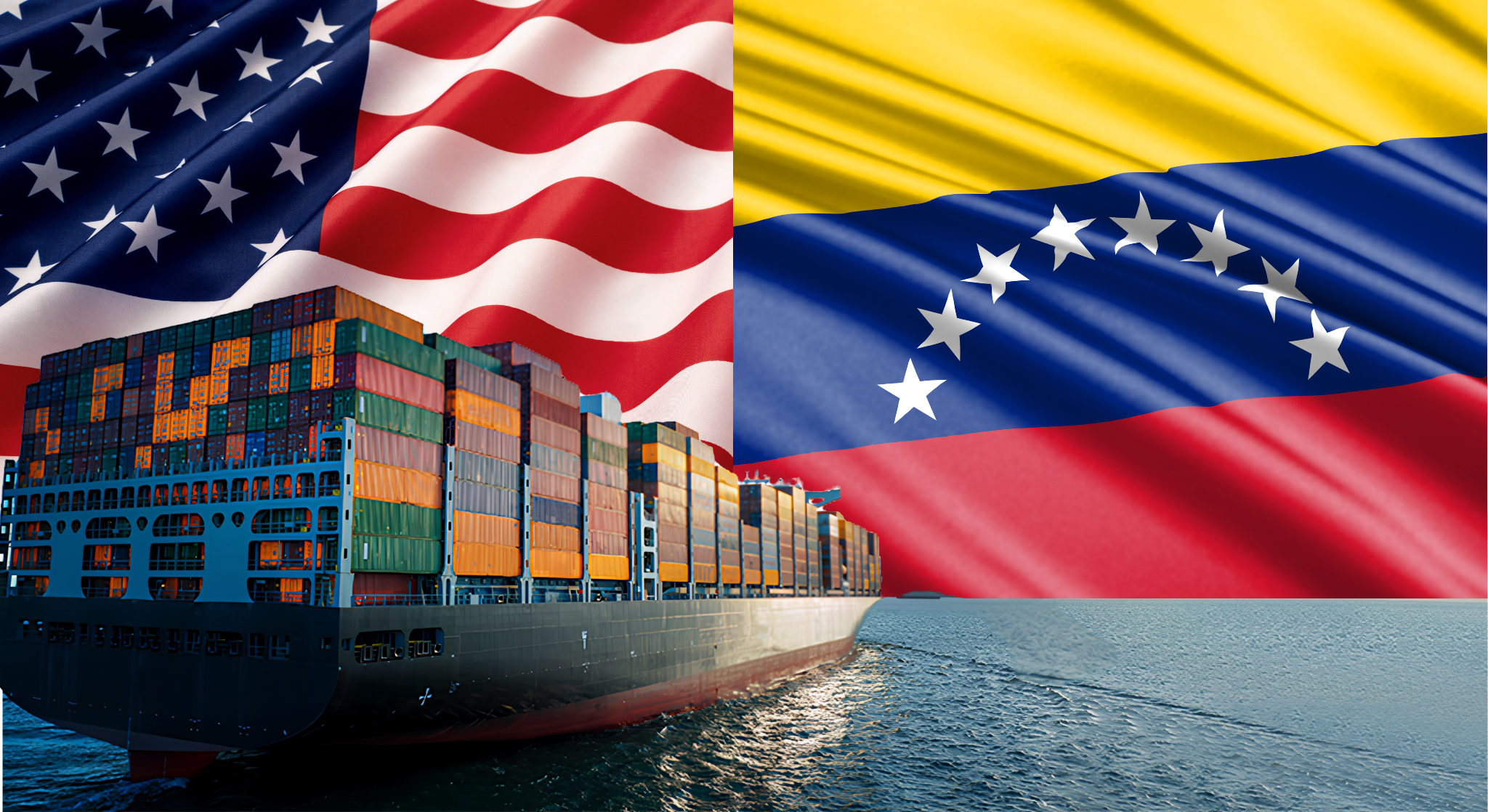
Legal Update: OFAC Addresses Legal and Practical Roadblocks for Businesses Investing in Key Venezuela Sectors, Amending General Licenses
Partner, Washington, D.C.
Key Takeaways:
- On June 10, 2026, the U.S. Department of the Treasury’s Office of Foreign Assets Control (OFAC), issued Venezuela-related General Licenses (GLs) 46C, 47A, 48B, 50B, 51B, 52A, and 54A.
- These amend existing GLs authorizing a broad range of activities within Venezuela’s energy, mining, and minerals sectors, but with two noteworthy changes:
- Broadening the scope of dispute resolution venues allowed for agreements authorized by the GLs beyond the United States to include the United Kingdom, France, and Singapore -- three main seats for international arbitration and all jurisdictions friendly to U.S. allies while shifting language from requiring such agreements by “governed by” the laws of a U.S. jurisdiction to being construed and interpreted under the such laws, affording flexibility for foreign dispute resolution; and
- Clarifying that compliance with certain Venezuelan laws and regulations related to labor, safety, environmental, and administrative licensing in the course of activities authorized by the GLs is authorized.
- Broadening the scope of dispute resolution venues allowed for agreements authorized by the GLs beyond the United States to include the United Kingdom, France, and Singapore -- three main seats for international arbitration and all jurisdictions friendly to U.S. allies while shifting language from requiring such agreements by “governed by” the laws of a U.S. jurisdiction to being construed and interpreted under the such laws, affording flexibility for foreign dispute resolution; and
- These significant changes mitigate potential compliance confusion and inconveniences for U.S. and non-U.S. businesses partaking in economic activities the GLs are designed to authorize, and in the case of non-U.S. persons, encourage participation in Venezuela’s new political landscape, thereby furthering U.S. policy goals. The amendments also signal OFAC’s commitment to addressing practical challenges that might deter businesses from investing in Venezuela’s economy.
- Such changes suggest potentially more upcoming modifications and clarifications as OFAC refines its policies based on private sector feedback, not just vis-à-vis Venezuela, but in other sanctions frameworks. OFAC may also implement similar authorizations accounting for the practical preferences and realities of U.S. multinational companies and their counterparts in friendly jurisdictions.
Background:
OFAC yesterday issued updated versions of seven Venezuela-related General Licenses (GLs) 46C, 47A, 48B, 50B, 51B, 52A, and 54A, covering oil exports, U.S. diluent sales, energy services, mining activities involving CVG Compañía General de Minería de Venezuela CA (Minerven), transactions with Petróleos de Venezuela, S.A. (PdVSA), and operations by major international energy companies. 1 All seven, issued under the authority of the Venezuelan Sanctions Regulations, 31 CFR Part 591 (the “VSR”) took effect immediately, replacing previous versions issued between February and March 2026.2 Crucially, none have expiration dates.
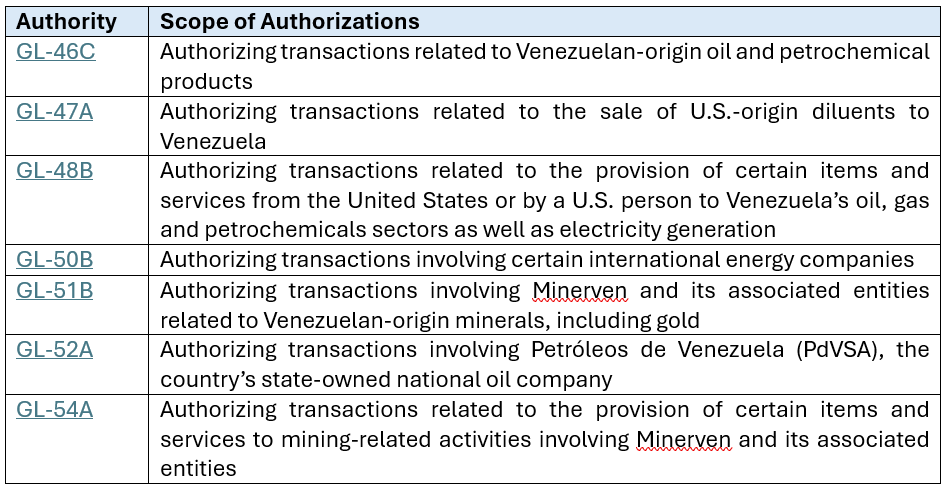
The amended GLs continue to instruct relevant parties to facilitate payments made to authorized parties that are otherwise blocked to the Foreign Government Deposit Fund or another account as instructed by the Treasury Department, pursuant to Executive Order (E.O.) 14373 (January 9, 2026).3 Payments made for local taxes, permits, or fees relating to relevant transactions with authorized Venezuelan entities need not be facilitated in this manner. Importantly, the aforementioned GLs do not authorize transacting with parties that are designated onto the List of Specially Designated Nationals and Blocked Parties (the SDN List) in connection with entities other than those included in the GLs, and businesses must take a holistic approach to prospective and current transactions to ensure compliance and address risks accordingly.
The updated GLs issued yesterday incorporate two noteworthy changes:
- OFAC has expanded the scope of permissible venues for dispute resolution to include the United Kingdom, France, and Singapore in agreements authorized by the GLs.4 Previously, dispute resolution proceedings could only occur in the United States.5 Similarly, the previous GLs required that the agreements be “governed by” the laws of a U.S. state or jurisdiction in the U.S., while the amendments require that they merely be “construed or interpreted” under the laws of such jurisdictions – enabling parties to alternative dispute resolution procedures to utilize the procedures of the respective fora, even if they are outside the United States.
- These revisions clarify that while agreements must be “Construed or interpreted” under governed by the laws of a U.S. state or jurisdiction in the U.S., this does not preclude recognition of and adherence to applicable Venezuelan law on labor, environmental compliance, administrative permits, health and safety, and other sovereign regulatory functions.6
.png)
These are addressed in detail below.
Inclusion of Non-U.S. Dispute Resolution Venues
The previous GLs specified in Paragraph (a)(1) that the laws of a U.S. state or other jurisdiction in the U.S. govern the contract and that any dispute resolution under the contract must occur in the United States.7 Although the newly issued GLs maintain that the terms of relevant agreements must be construed in accordance with the laws of a U.S. state or other jurisdiction in the U.S., they provide that dispute resolution proceedings may occur in three additional venues: the United Kingdom, France, or Singapore.8 Furthermore, OFAC FAQ 1260 provides that if the parties were to submit their dispute to arbitration, applicable procedural rules include those agreed upon by the parties, the rules of internationally recognized institutions, or the rules of the seat of arbitration.9
Significance:
- Recognizes Compliance Challenges of Multinational Companies. Providing the option for three additional dispute resolution venues outside the United States, each with leading arbitral fora, acknowledges practical compliance challenges faced by international companies and investors that these GLs are intended to enable.
- Aligns with International Standards and Practices. The modification permits increased flexibility to align such agreements to existing contractual practices in accordance with more globally established practices, accommodating the preferences of multinationals, allowing, for example, the use of arbitration at established venues such as the London Court of International Arbitration (LCIA), The International Chamber of Commerce (ICC) in Paris, or the Singapore International Arbitration Centre (SIAC). Notably, among the entities permitted by GL 50B (previously GL 50A), BP PLC, Eni S.p.A., Établissements Maurel & Prom SA, Repsol S.A., and Shell PLC are based in the United Kingdom or the European Union.
The additional three arbitration venues reflect international trends in the sector.
As detailed above and as FAQ 1260 affirms, the United Kingdom, France, and Singapore, are each home to a main global arbitration seat which collectively represent the world’s three major seats. For alternative dispute resolutions, given that many multinational energy companies are headquartered in the United Kingdom and France, these countries are preferred, reliable venues that are well known by the commercial sector. By introducing these jurisdictions, OFAC is also facilitating transactions with Venezuela by offering non-U.S. persons and Venezuelan parties more international, less-U.S.-centric alternatives that also may convey a broader sense of neutrality to businesses. Concurrently, by continuing to require U.S. jurisdiction laws to govern agreements relying on these authorizations, OFAC is ensuring that it does not greenlight activities that could contravene U.S. policy.
Clarifications on Compliance with Venezuelan Laws and Regulations
The second change in the current versions of the GLs clarifies the first part of the requirements in paragraph (a)(1): while the contracts must be construed and interpreted under the laws of a U.S. state or other jurisdiction in the U.S., the contracts can recognize compliance with applicable Venezuelan laws and regulations in certain activities such as administrative permits and licenses, concessions, labor, environmental, health and safety, and other mandatory regulatory requirements.10
Significance:
- Conveys OFAC’s recognition of the practicalities of day-to-day operations of a multinational business in-country. The change also aligns the Administration’s policy without encumbering it with limitations that do not materially benefit that policy. Allowing LCIA, ICC, or SIAC arbitration for such agreements increases the likelihood of the arrangements envisioned by the Trump Administration materializing without compromising U.S. policy objectives of keeping disputes over such contracts from being heard in less friendly jurisdictions.
- Prevents Needless Deterrence and Derisking. By clarifying the policy, OFAC has removed key ambiguity by providing pointed direction. This addresses a common shortcoming of GLs which causes parties, especially those outside the U.S., to adopt risk-averse positions far exceeding limitations imposed by law.
What Should Businesses Expect?
- Accommodation of Operational Challenges: The amended GLs reflect a pragmatic commitment by OFAC and the Treasury Department to make certain sectors of the Venezuelan economy accessible to U.S. investment and investment from certain non-U.S. companies. The current authorizations signal continuous efforts by OFAC to accommodate practical and legal challenges faced by multinationals seeking to participate in the Venezuelan economy in adherence to these licenses, while putting U.S. interests at the forefront.
- Alignment with Venezuelan Reform Efforts: This development reflects the January 2026 amendments to Venezuela’s Hydrocarbons Laws, which (1) ease the state’s control in foreign private investments, and (2) allow for independent arbitration of disputes. The amended GLs effectively serve as an acknowledgment by the United States of legislative changes by Venezuela’s government. At the same time, the updated authorizations continue enabling investments in Venezuela’s energy sectors despite complex transactional and legal compliance challenges.
- Persisting Compliance Considerations: Importantly, the current GLs only provide partial relief of U.S. sanctions targeting Venezuela. Businesses must continue conducting vigilant due diligence and seek guidance when applicable to ensure their activities remain compliant with the authorizations established by these GLs.
- Possible Emerging U.S. Sanctions Policy Trends: Yesterday’s updates address both the engagement of U.S. allies vis-à-vis Venezuela as well as operational practicalities. Such liberalizations are being implemented at a more calibrated pace compared to the near-overnight changes seen with the Syria sanctions and export controls framework following the fall of Bashar Assad’s government in 2024, accounting for the contrasting underlying political shifts and policies. Importantly, it could provide a model for OFAC in issuing future relief when unraveling or phasing out other sanctions frameworks. OFAC will likely continue incorporating market feedback on sanctions implementation and revise conditional authorizations as needed, enabling routine, inoffensive activities necessary to facilitate commercial transactions the agency views favorably.
Please contact Farhad Alavi (Washington) at falavi@akrivislaw.com or +1.202.686.4859 if you have any questions.
Special thanks to John Kallas and Kristen Xiao for their assistance in preparing this Legal Update.
This Legal Update is intended solely for informational purposes and should in no way be construed as legal advice, nor shall the information shared here result in or constitute the formation of an attorney-client relationship with anyone who reads it. If you have any questions or are unclear on any of the subject matters addressed or discussed in this Legal Update, please consult a licensed legal professional.
Citations:
[1] U.S. Dep’t. of the Treas., Off. of Foreign Assets Control, Venezuela General License No. 46C, “Authorizing Certain Activities Involving Venezuelan-Origin Oil or Petrochemical Products”; U.S. Dep’t. of the Treas., Off. of Foreign Assets Control, Venezuela General License No. 47A, “Authorizing the Sale of U.S.-Origin Diluents to Venezuela”; U.S. Dep’t. of the Treas., Off. of Foreign Assets Control, Venezuela General License No. 48B, “Authorizing the Supply of Certain Items and Services to Venezuela”; U.S. Dep’t. of the Treas., Off. of Foreign Assets Control, Venezuela General License No. 50B, “Authorizing Transactions Related to Oil or Gas Sector Operations in Venezuela of Certain Entities”; U.S. Dep’t. of the Treas., Off. of Foreign Assets Control, Venezuela General License No. 51B, “Authorizing Certain Activities Involving Venezuelan-Origin Minerals, Including Gold”; U.S. Dep’t. of the Treas., Off. of Foreign Assets Control, Venezuela General License No. 52A, “Authorizing Certain Transactions Involving Petróleos de Venezuela, S.A”; U.S. Dep’t. of the Treas., Off. of Foreign Assets Control, Venezuela General License No. 54A, “Authorizing the Supply of Certain Items and Services for Minerals Operations in Venezuela”.
[2] See, e.g., Publication of Venezuela Sanctions Regulations Web General Licenses 48A and 49A, 91 FR 35143 (June 10, 2026).
[3] Exec. Order No. 14373, 91 F.R. 2045 (2026).
[4] See, e.g., U.S. Dep’t. of the Treas., Off. of Foreign Assets Control, Venezuela General License No. 46C.
[5] See, e.g., U.S. Dep’t. of the Treas., Off. of Foreign Assets Control, Venezuela General License No. 46B.
[6] OFAC FAQ #1260: Does the requirement in certain Venezuela General Licenses (e.g., 46C, 47A, 48B, 50B, 51B, 52A, and 54A) that the terms of contracts be construed and interpreted in accordance with the laws of a state or other jurisdiction within the United States mean that U.S. law must govern all aspects of the underlying activity?, U.S. Dep’t of the Treas., Off. Of Foreign Assets Control, https://ofac.treasury.gov/faqs/1260 (updated June 10, 2026).
[7] See, e.g., U.S. Dep’t. of the Treas., Off. of Foreign Assets Control, Venezuela General License No. 46B(a)(1), “the laws of the United States or any jurisdiction within the United States govern the contract and that any dispute resolution under the contract occur in the United States."
[8] See, e.g., U.S. Dep’t. of the Treas., Off. of Foreign Assets Control, Venezuela General License No. 46C(a)(1)(ii), “dispute resolution proceedings relating to the contract occur in the United States, the United Kingdom, France, or Singapore”.
[9] U.S. Dep’t of the Treas., Off. Of Foreign Assets Control, Frequently Asked Questions No. 1260 (Jun. 10, 2026), https://ofac.treasury.gov/faqs/1260.
[10] See, e.g., U.S. Dep’t. of the Treas., Off. of Foreign Assets Control, Venezuela General License No. 46C(a) n. 4, “The requirement in paragraph (a)(1)(i) permits the inclusion of contract terms that recognize that certain aspects of the underlying activity in Venezuela may be subject to applicable Venezuelan law and regulations, including laws and regulations governing the exercise of Venezuela’s sovereign regulatory authority, administrative permits and licenses, concessions, labor, environmental, health and safety, and other mandatory regulatory requirements.”
.png)