.avif)
Legal Update: US Treasury Targets UAE Branches of Egypt’s Banque Misr as part of Broader Actions against Iran’s Shadow Banking Activities


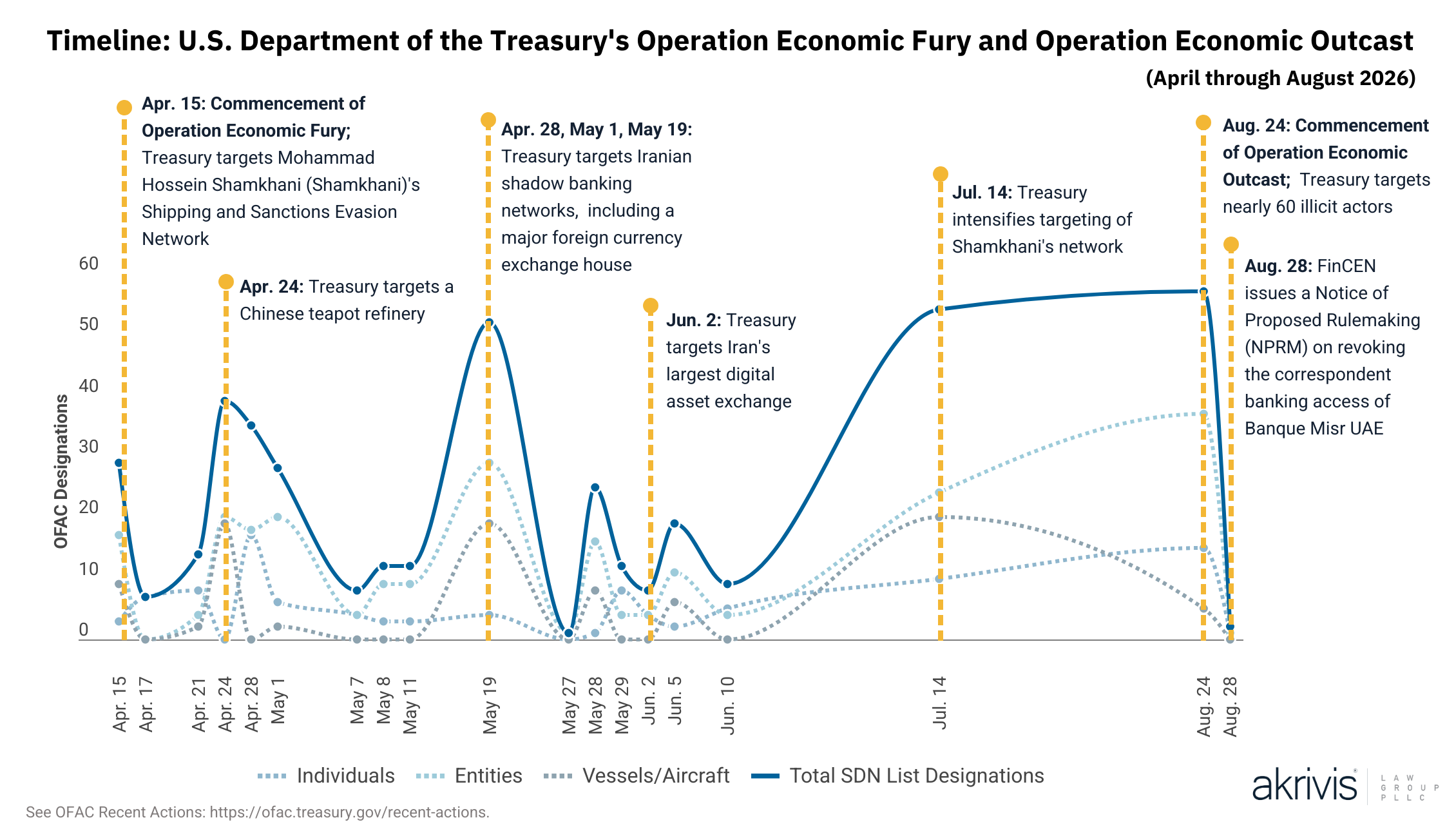
On August 28, 2026, the U.S. Treasury Department’s Financial Crimes Enforcement Network (FinCEN) issued a Notice of Proposed Rulemaking (NPRM) that would prohibit U.S. financial institutions from opening or maintaining correspondent accounts for the UAE branches of Egypt’s Banque Misr (“Banque Misr UAE1”) as part of the Trump Administration’s “Operation Economic Outcast” against Iran. This action could have consequences beyond this particular bank and signal potential measures against similarly situated financial institutions in the coming weeks.
Key Takeaways and Recommendations for Banks:
- FinCEN’s NPRM identified the five UAE branches of Banque Misr, Egypt’s second largest bank, to be of “primary money laundering concern,” and proposed special measures that would bar U.S. financial institutions from opening or maintaining correspondent accounts for these branches, shutting off their direct access to U.S. dollar clearing facilities. According to FinCEN, the branches processed $1.8 billion in payments for customers accused of acting as front companies for illicit Iranian actors over a 30-month period.2
- While the NPRM may be lifted before it is finalized due to mitigating efforts by the bank or via a political settlement, the short-term effects of this action will likely bear lasting consequences for Banque Misr extending far beyond its UAE footprint and communicates a clear message to other financial institutions that have potential exposure to Iran. This message is of particular importance to non-U.S. banks.
- FinCEN’s action followed an August 24, 2026 announcement by the U.S. Department of the Treasury’s Office of Foreign Assets Control (OFAC) of new sanctions against Iran, wherein OFAC, inter alia, (1) designated nearly 60 individuals, entities, and vessels; (2) suspended multiple general licenses in its Iran program including authorizations for non-commercial remittances between the U.S. and Iran; and (3) implemented five new sectoral determinations under E.O. 13902 (January 10, 2020) enabling designations of entities involved in the aviation, digital asset, gold, shipping, and technology sectors of Iran’s economy.3
- As explained in more detail below, FinCEN’s action is likely to increase scrutiny on financial institutions and correspondent accounts. There are steps that financial institutions can take now to identify and remediate potential exposure to activities described in the NPRM and relevant FinCEN and OFAC guidance.
Details of FinCEN’s Proposed Rulemaking on Banque Misr UAE:
The NPRM states that Banque Misr’s UAE branches have served as a “critical access node to the U.S. dollar” for “Iranian illicit finance”. The central banks of the UAE and Egypt issued a joint statement indicating that Banque Misr’s UAE branches continue to operate and that “the branches of Banque Misr in the UAE will take all necessary actions and measures” following FinCEN’s action.4
Using FinCEN’s authority under Section 311 of the USA PATRIOT Act5 (Section 311), the proposed rule, if implemented, will:
- Prohibit U.S. financial institutions from opening or maintaining a correspondent account in the United States for, or on behalf of, Banque Misr UAE, thereby effectively shutting off the branches’ ability to clear U.S. dollar transactions. FinCEN noted the branches currently have three U.S. correspondent relationships;
- Require covered financial institutions6 to “take reasonable steps” not to process transactions involving Banque Misr UAE through correspondent accounts held in the United States for other non-U.S. financial institutions; and
- Require “special due diligence” to guard against correspondent accounts being used for transactions involving Banque Misr UAE.
The NPRM provides for a 30-day notice-and-comment period, after which FinCEN will issue a final rule.
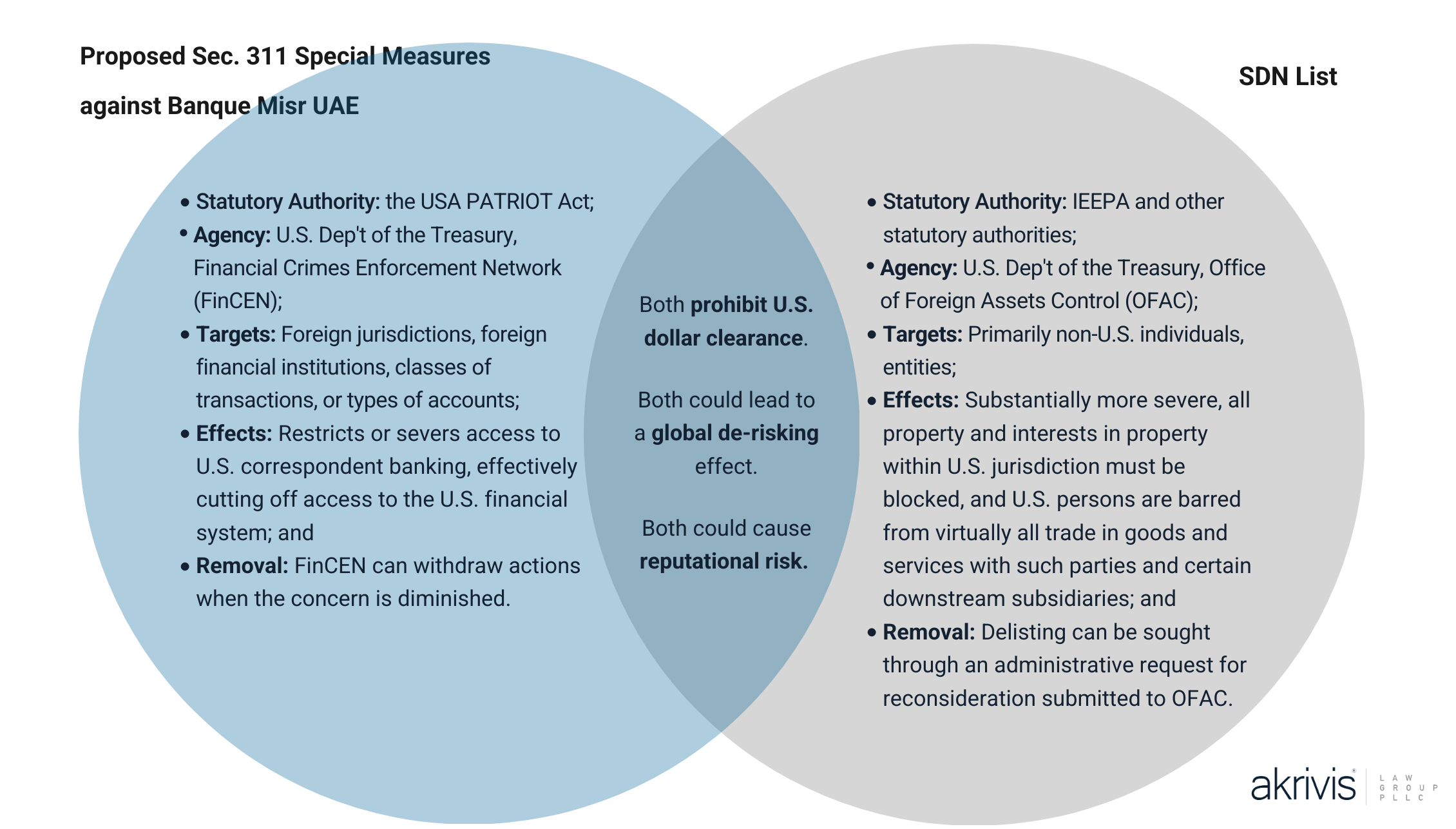
Importantly, FinCEN’s proposed rule does not impose blocking sanctions or freeze assets of Banque Misr UAE akin to the List of Specially Designated Nationals and Blocked Persons (the “SDN List”) maintained by OFAC. It applies only to Banque Misr’s branches in the UAE and does not apply to the Egyptian parent or the bank’s other operations internationally. Unlike the case with entities on the SDN List, U.S. persons are not categorically prohibited from transacting with Banque Misr UAE.
Notwithstanding the limitations of FinCEN’s proposed rule, the allegations in the NPRM could cause counterparts to “de-risk” from activities involving the bank or its UAE branches. As a result, the NPRM is likely to have a broader impact in practice than merely restricting U.S. correspondent accounts, even if the rule is never finalized.
FinCEN has previously implemented measures under Section 311 against banks in numerous countries and jurisdictions such as Iran, North Korea, and Burma (Myanmar).7 Section 311 is part of the broader USA PATRIOT Act adopted in 2001 following the terrorist attacks of September 11, 2001, and authorizes menu-based restrictions on U.S. financial institutions’ transactions with targets designated as “primary money laundering concerns” posing a threat to U.S. national security, namely money laundering and terrorism finance risks.
In the case of Banque Misr UAE, FinCEN’s expectation is clear, with the NPRM stating, in relevant part:
Special due diligence also includes implementing risk-based procedures designed to identify any use of correspondent accounts to process transactions involving Banque Misr UAE. A covered financial institution would be expected to apply an appropriate screening mechanism to identify a funds transfer order that on its face listed Banque Misr UAE as the financial institution of the originator or beneficiary, or otherwise referenced Banque Misr UAE in a manner detectable under the financial institution’s normal screening mechanisms. An appropriate screening mechanism could be the mechanisms used by a covered financial institution to comply with various legal requirements, such as commercially available software programs used to comply with the economic sanctions programs administered by the OFAC.8
Compliance Considerations for Financial Institutions:
FinCEN’s August 28 action highlights three key points:
- The Trump Administration is determined and willing to target banks in friendly countries as part of its efforts against Iran.
- This action touched on two key U.S. allies in the Middle East, Egypt and the UAE, noting that the latter is a major global financial hub. The NPRM explicitly states that FinCEN is unaware of any action by other jurisdictions against Banque Misr UAE. Furthermore, Banque Misr is not a fringe actor in the Middle East North Africa (MENA) region, but rather an established bank with a footprint that extends to Europe. This demonstrates the United States will not spare banks or other companies based or operating in allied jurisdictions in its efforts to curtail the Iranian regime’s access to international banking networks.
- This action touched on two key U.S. allies in the Middle East, Egypt and the UAE, noting that the latter is a major global financial hub. The NPRM explicitly states that FinCEN is unaware of any action by other jurisdictions against Banque Misr UAE. Furthermore, Banque Misr is not a fringe actor in the Middle East North Africa (MENA) region, but rather an established bank with a footprint that extends to Europe. This demonstrates the United States will not spare banks or other companies based or operating in allied jurisdictions in its efforts to curtail the Iranian regime’s access to international banking networks.
- FinCEN is not required to publicly litigate detailed allegations before taking action.
- While FinCEN has provided substantially more detail than what OFAC may typically provide in a press release when designating a bank to the SDN List, the details in this case are still comparatively scant. Under Section 311, the Treasury Department need only present “reasonable grounds” for concluding that a financial institution is a primary money laundering concern. Additionally, as with OFAC, FinCEN may rely on confidential or classified sources.
- The burden of rectifying a situation falls to the target of the Section 311 designation. Unlike an OFAC designation, the FinCEN NPRM provides a notice-and-comment period during which the bank could communicate with the U.S. government to try to avoid the issuance of a final rule. However, FinCEN is not obliged to disclose confidential or classified information to assist in that process.
- FinCEN has an extensive ability to gather information on foreign banks. Beyond publicly available and other intelligence, U.S. law subjects correspondent banking relationships to broad disclosure requirements. For example, 31 C.F.R. § 1010.670 authorizes the U.S. Treasury Secretary or Attorney General to issue summons or subpoenas regarding transactions processed through U.S. correspondent accounts.
- While FinCEN has provided substantially more detail than what OFAC may typically provide in a press release when designating a bank to the SDN List, the details in this case are still comparatively scant. Under Section 311, the Treasury Department need only present “reasonable grounds” for concluding that a financial institution is a primary money laundering concern. Additionally, as with OFAC, FinCEN may rely on confidential or classified sources.
- FinCEN’s NPRM emphasizes the need for financial institutions to implement effective compliance programs to maintain U.S. correspondent access.
- Global regulations adopted under the Financial Action Task Force (FATF) framework, including those in the UAE, require banks to adopt “Know Your Customer” (KYC), customer due diligence (CDD), and transaction monitoring programs. The NPRM refers to 103 customers of Banque Misr’s UAE branches suspected of being “potential shadow Iranian front companies.” While FinCEN does not comment on whether the branches breached UAE regulations, the action indicates that banks processing transactions through U.S. correspondent accounts will be held to a high standard. These expectations trickle down through U.S. correspondent banks applying due diligence to their own foreign correspondent relationships.
- In response to financial isolation cascading from U.S. and other western sanctions, Iran has increasingly relied on an expanding “shadow banking” network that uses shell companies in third country jurisdictions that may often have short operational lifespans. OFAC highlighted this in a May 1, 2026 press release.
- Screening of customer names and transactions is not sufficient. FinCEN named three examples of Banque Misr UAE customers in the NPRM that were suspected of facilitating flows of illicit finance. None of the three customers were on the SDN List at the time of the identified transactions, and one of them is still not listed as of August 31, 2026. In other words, banks cannot rely on OFAC to identify high-risk accounts and must perform risk-based due diligence on their customers and transactions. This includes risk-based transaction monitoring and CDD controls designed to detect potential Iranian touchpoints.
- FinCEN and OFAC have published extensive guidance, including examples of typologies associated with Iranian shadow banking activity. U.S. agencies expect financial institutions inside and outside the United States to have read and applied this information to their compliance programs.
- Global regulations adopted under the Financial Action Task Force (FATF) framework, including those in the UAE, require banks to adopt “Know Your Customer” (KYC), customer due diligence (CDD), and transaction monitoring programs. The NPRM refers to 103 customers of Banque Misr’s UAE branches suspected of being “potential shadow Iranian front companies.” While FinCEN does not comment on whether the branches breached UAE regulations, the action indicates that banks processing transactions through U.S. correspondent accounts will be held to a high standard. These expectations trickle down through U.S. correspondent banks applying due diligence to their own foreign correspondent relationships.
As the U.S. government is placing renewed attention on financial institutions under Operation Economic Outcast, both U.S. and non-U.S. financial institutions should properly gauge their exposure and consider how this change in strategy and FinCEN's proposed rule could affect their operations and commercial relationships.
For more information, contact:
- Farhad Alavi at falavi@akrivislaw.com
- Nick Turner at nturner@akrivislaw.com
Special thanks to Kristen Xiao for her assistance in preparing this Legal Update.
This Legal Update is intended solely for informational purposes and should in no way be construed as legal advice, nor shall the information shared here result in or constitute the formation of an attorney-client relationship with anyone who reads it. If you have any questions or are unclear on any of the subject matters addressed or discussed in this Legal Update, please consult a licensed legal professional.
---------------------------------------------------------------------
[1] Banque Misr operates in the UAE through branches of the Egyptian parent rather than a separate UAE subsidiary.
[2] Proposal of Special Measure Regarding Banque Misr UAE as a Financial Institution Operating Outside of the United States of Primary Money Laundering Concern, Fin. Crimes Enforcement Network at 9 (proposed Aug. 28, 2026) (to be codified at 31 C.F.R. § 1010), https://public-inspection.federalregister.gov/2026-17871.pdf.
[3] Press Release, U.S. Dep’t of the Treasury, Treasury Launches Unprecedented Campaign Against Iranian Regime on Economic D-Day (Aug. 24, 2026), https://home.treasury.gov/news/press-releases/sb0613/.
[4] Statement No. (1) Regarding Banque Misr’s UAE Branch: Joint Statement by the Central Bank of Egypt and the Central Bank of the United Arab Emirates, Banque Misr (Aug. 30, 2026, 7:00pm), https://www.banquemisr.com/en/ABOUT-US/News/Joint-statement-No-1-for-CBE-and-CBUAE-regarding-Banque-Misr-UAE.
[5] Uniting and Strengthening America by Providing Appropriate Tools Required to Intercept and Obstruct Terrorism Act of 2001, Public Law 107–56, 115 Stat. 272 (Oct. 26, 2001) (USA PATRIOT Act).
[6] See the definition of “covered financial institutions” in 31 C.F.R. §1010.605(e)(1).
[7] U.S. Dep’t of the Treasury, Fin. Crimes Enforcement Network, Special Measures for Jurisdictions, Financial Institutions, or International Transactions of Primary Money Laundering Concern, https://www.fincen.gov/resources/statutes-and-regulations/special-measures (last visited Aug. 31, 2026).
[8] Proposal of Special Measure Regarding Banque Misr UAE as a Financial Institution Operating Outside of the United States of Primary Money Laundering Concern, Fin. Crimes Enforcement Network at 22 (proposed Aug. 28, 2026) (to be codified at 31 C.F.R. § 1010), https://public-inspection.federalregister.gov/2026-17871.pdf.

.png)